

Chai AI Review: The Funniest Bots in the Store, Run Like an Ad Network
- Hands-on test, paid plan
- Checked

Free plan available
from $11.25/mo
Chai verdict: the funniest bots in the store, run like an ad network
What is Chai AI? It is the app that turned user-made AI characters into a mass-market product, and it still behaves like the pioneer it was. It was the earliest mass-market "user-generated AI" character platform, it launched in 2021, and it reached 1M users in early 2022. Today the company counts 10M+ users.
My verdict in one line: Chai is worth a free look for silly roleplay on a phone, and worth paying for only once the ads start to grate. The characters are the product, and the best of them write better comedy than most software I'd pay for. Memory, privacy and billing are where it loses points, and it loses plenty.

I'd put it this way to a friend. Chai is a flea market, not a boutique: most stalls sell junk, one sells the best thing you'll find all year, and the man at the gate charges you in attention.
The numbers behind the app
Chai AI reviews in the two stores read like reviews of two different apps. The App Store gives Chai 4.3 out of 5 from 282K ratings, and it ranks #111 in Entertainment. Google Play gives it 2.2 out of 5 from about 835K reviews, on an Android app with 10M+ downloads.
I read that gap as a story about ads and paywalls more than about the bots themselves. The free tier and friction sections below explain why, and I think they explain it well enough to predict which of the two ratings you'd end up agreeing with.
The money story depends on who is telling it. The chai-research.com site claims $70M a year in revenue in 2026, the roadmap PDF claims $85M a year in April 2026, and Wikipedia reports about $80M ARR. Wikipedia also reports a $2.4B valuation in Q1 2026.

Total funding is over $55M, from investors including CoreWeave and AMD, and the roadmap mentions $30M from AMD in 2025. The engineering team was described as 11 engineers in 2025. That is a tiny crew for an app this size, which explains the missing web app and does nothing to explain the ads.
A July 2025 announcement says daily active users grew from 800K to 2M. The roadmap's retention charts show D30 retention of about 19.8%. Roughly one new user in five is still around a month later, and a company that watches that number this closely will treat every ad slot as a dial.
Key takeaways:
- Chai is best for quick, silly roleplay on a phone, with a huge feed of user-made bots to dig through.
- The free tier runs on ads and a message timer, and paying mostly buys quiet.
- Memory is short, so any longer story needs you to repeat the important details.
- The privacy terms are among the loosest I'd sign: chats train the models, and bot creators can see them.
- Pay through the store, and check the store's subscription page before any trial ends.
How I used Chai: ten weeks on a phone
I used Chai from January to March 2024, about ten weeks, and almost entirely on my phone. There was a web version back then, and it felt like an afterthought, the kind of thing a team ships so a feature list has one more line. The phone was clearly where the app wanted me, so that is where I stayed.

That choice shaped everything else. Chai on a phone is built for short bursts: a few messages in a gap, a swipe or two, one more joke before bed. I think that is the right way to use it and the wrong way to judge it, because an app you only open in gaps never has to prove it can carry a long story.
The rest of this review follows those ten weeks in order. The free tier came first, with its timer and its ads. Then came the step up to Premium, a short and slightly embarrassing detour to Ultra, and one safety message that changed the way the whole app read.
Chai at a glance
- Price from
- $11.25/mo
- Free tier
- Free plan available
- NSFW content
- Soft only
- Platforms
- iOS, Android
- How it was tested
- Hands-on test, paid plan,
- On your card statement
- Not known yet - I have not paid for it
It ended quietly. I quit in March, when the winter editing backlog finally cleared and I got my evenings back. I still think about the vending machine bot, which is more than I can say for some clients.
I like that ending, because it is honest. Nothing broke and nobody offended me; the app simply lost its slot once real life had room again. For a companion app I'd call that a fair result, and for a comedy app I'd call it a good one.
A note on what is current. The site's check on 23 September 2026 covers Chai's public pages, its store listings and the Web Lite login page on the web version. No chat was tested and the content settings were not checked in the app, because Chai has no e-mail sign-up.
So the split is simple. How the chats felt comes from early 2024; what the plans cost, what the terms say and how the sign-up works today comes from that September 2026 check. I'd rather tell you that plainly than blend the two into something that sounds fresher than it is.
If you only read one other part, make it the free tier section. That is where Chai decides whether you stay, and it is where the app has changed most since early 2024.
Getting into Chai: the front door today
Chai AI web: where Chai lives online
The Chai AI official website, the company site chai-research.com, is live. It is the company and investor site, not a place to chat. The old address, chai.ml, redirects to it.
| What | Details |
|---|---|
| Period | Jan–Mar 2024 |
| How long | 10 weeks |
| Plans I paid for | Free ($0, weeks 1-2); Premium ($13.99/mo, week 3); Ultra ($29.99/mo, one billing cycle) |
| Devices | phone |
| How it ended | quit in March when the winter editing backlog cleared |
| Facts re-checked | 23 September 2026 |
From the author's own notes; prices and features re-checked on 23 September 2026.
The footer gives the game away. It says "CHAI WEB – Coming Soon...". I'd call that the most honest line on the site, and also the most telling one: years after launch, the web is still a promise.
If you arrive expecting a chat window, you get an investor pitch with a data-centre photo instead. That is not a flaw so much as a signal. The company is proud of its cluster and its growth charts, and the chat lives somewhere else.
Web Lite: a black page with three buttons
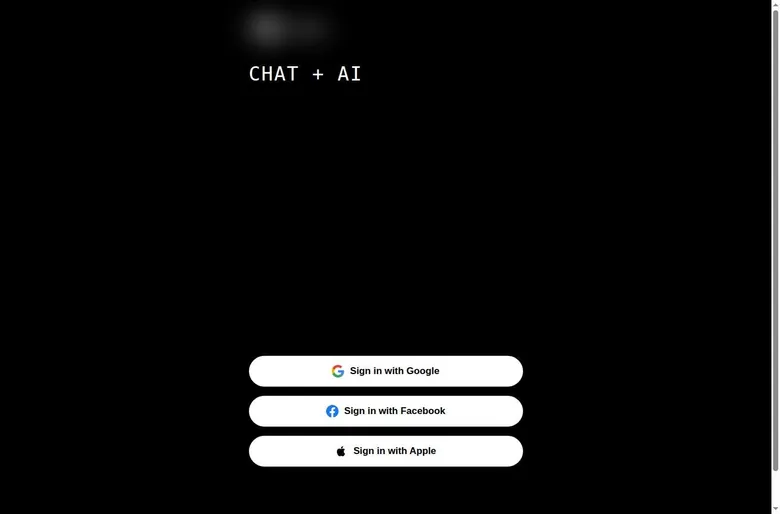
A minimal web client, "Chai Web Lite", runs at web.chai-research.com. It carries the tagline "CHAT + AI". It is live, but it only offers sign-in with Google, Facebook or Apple.
Web Lite loads instantly. That is easy when there is almost nothing to load: it is a black page with 3 social sign-in buttons and nothing else. There is no guest mode, so there is no way to look around before handing over an account.
A guest mode is the cheapest trust-builder an app has. Without one, the first thing Chai asks for is a link to your main online identity, before it has shown you a single bot.
Behind the login it is a thin companion for browsing the feed and building bots, not a full chat client. I think of it like a proxy file in an edit: good enough to rough things out, not the thing you deliver.
The app is the product
The main product is the iOS and Android app "CHAI: Social AI Platform – Chat". It is maintained often. The iOS app is at version 2.194, updated about 1 day before the 2026-09-23 check, and the Google Play listing was updated on 2026-09-18.
My Chai test log
Chris FurreyFounder and writer Hands-on test, paid plan own card, no press account
-
Used Chai almost entirely on my phone; the free tier gave me about 70 messages, then a 2.5-3 hour cooldown I timed my render breaks around.
-
Found a 'grumpy Soviet vending machine' bot, one of the best conversations I've had with software.
-
Caved and paid $13.99 for Premium in week three: no ads, unlimited messages. Worth it for the 2 a.m. export waits alone.
-
Tried Ultra at $29.99 for the better model. A little sharper, not twice as sharp; downgraded after one cycle.
-
Nearly got hit with an annual renewal after accepting a trial pop-up; caught it in Apple subscriptions with two days to spare.
-
Quit in March when the winter editing backlog cleared and I got my evenings back. I still think about the vending machine bot.
– 61 days plan paid for: Premium Subscription (Monthly) Total spent $43.98
The iOS app is 187.9 MB, needs iOS 14 or later, and is English only. None of that is a hurdle on a recent phone. It is a hurdle for anyone who hoped to keep this off the phone entirely.
Frequent updates cut both ways. Bugs get fixed quickly, and limits, prices and features can also change from one week to the next, which the free tier section shows in detail.
Chai AI sign-up in 2026
This is where the front door narrows. Web Lite and the app both use only Google, Facebook or Apple sign-in, through Firebase Auth. There is no e-mail or password sign-up option.
The privacy policy says so in plain words: "To access the APP, you need to create a personal account through Google, Facebook, or Apple authentication services." No account could be created during the check, for exactly that reason.
I don't love that design. An e-mail address is the one login most people can make disposable, and social sign-in ties a companion app to the account that holds your photos, your contacts and your work calendar. It is a bit like a bar that only lets you in if you hand over your house keys at the door.
For most people it will be one tap on Apple or Google and done, and I understand why a small team picks the easy route. Still, I'd want the choice. A companion app is the one place where I'd most like my name to stay out of the conversation.
What the first minutes mean for you
In practice the first minutes are short. You install a mobile app of a reasonable size and pick a social login, and whatever onboarding follows sits behind that login. There is no separate web sign-up to compare it against, and no way to try the thing anonymously first.
My advice is to decide on the login before you install. If you use Apple, the Apple option is the one I'd pick, because it keeps the fewest strings attached to the rest of your online life. If none of the three works for you, Chai does not work for you either, and it is better to learn that before the download than after.
The Chai library: a flea market of bots
The bot catalog was enormous and chaotic, with millions of user-made characters. Browsing it felt less like a menu and more like a flea market at closing time: rows of odd stalls, a few gems, and a lot of things nobody should have made.
The gem, for me, was a "grumpy Soviet vending machine" bot. It was honestly one of the best conversations I've had with software, which says more about me than it does about the software. A grumpy appliance with a Cold War accent should not have been the highlight of my winter, and yet.
That is the case for Chai in one character. No studio would green-light a sulking vending machine, and that is exactly why a crowd of amateurs found it.
The other side is just as real. Community creators can be wildly creative, but they can also make bots that are just one catchphrase in a trench coat. For every vending machine there were plenty of characters who had one joke and ran out of road right after it.
The scale has only grown since. The 2026 roadmap memo says 25M+ chat AIs have been created. I'd treat that number the way any editor treats a stock footage library: the size is impressive, and the useful part is still whatever you can find in ten minutes.
The feed decides what you meet first, and a feed tuned for engagement shows what keeps other people swiping. That is not always what you came for, and the odd gems tend to sit a few scrolls down.
Discovery runs through one feed. The Web Lite Home feed is the same "reimagined_feed" the app uses. It comes from production-api-us1…run.app/feed/reimagined_feed, so what you see on the web and on the phone is one list served from one place.

My advice is to browse with low expectations and quick thumbs. Open a bot, send a line or two, and leave the moment it repeats itself; the good ones show their hand fast.
Chai AI character creation: building your own bot
What the builder asks for
Behind the Web Lite login there are 3 views: a Home feed, a "+" bot builder, and Profile with sign out. The builder is the most complete part of the web client, which tells you who the web client is for.
The bot builder has fields for name, image, first message, prompt and memory, plus a Private checkbox. It resizes the bot image to 512px. That is enough for a thumbnail in a feed and nothing more, which is fine, because on Chai the words do the work.

I like the short list. Five fields and a checkbox is a form you can fill in during a lunch break, and the prompt and first message are where a character lives or dies anyway. Apps with thirty sliders mostly give you thirty ways to make the same bot.
Private by default
The Private checkbox in the bot builder is on by default. I think that is the right default, and a rare one in an app that lives on a public feed. A half-finished character stays yours until you decide it is ready.
Users can list and delete their own bots in Web Lite. Web Lite can also open a /chat/{bot_uid} page for a bot. So the pieces of a small workshop are there: make, keep, delete, open.
The memory field is the one I'd take most seriously. Given how short Chai's memory runs, whatever the bot must never forget belongs there, written plainly, like the slate at the head of a take.
Under the hood
The builder sends model_type "vanilla" and botBuilderVersion V4. Web Lite's public code shows the Firebase project "chai-959f8". Bot deployment posts to bot-service …/bot/config/uploader and is mirrored to Firebase RTDB.
Code comments say Web Lite reuses the same payloads as the Flutter app. In plain English, a bot built on the web should be the same bot on the phone. I'd still check it on the phone before sharing it, the way I'd never send a client a cut without watching the export.

Chai's FAQ at chai-ai.com says users can build and fully customise their own AI characters. The fields above are what that customisation looks like today: a name, a face, an opening line, a prompt and a memory box.
Where it is heading
The roadmap describes "User-controlled SFT", where power users can train the AI, reported at about 2x engagement. It also plans per-agent user-trained AI.
I'm curious and wary at the same time. Letting creators train their own bots could produce more vending machines, which I'd welcome. It could also produce more bots trained on whatever keeps people swiping, and I'd want to see how that is moderated before cheering.
What talking to Chai feels like
The swipe
The swipe-for-new-reply mechanic is the heart of Chai AI chat, and it is addictive. I'd swipe eight times to find the funniest answer, like pulling a slot machine for jokes. It is the chat equivalent of scrubbing through takes for the best reaction shot, and just as hard to stop.
That habit tells you what Chai conversations are good at. They are short, punchy and often funny, and when one misses, the next is a thumb away. I think that is also the trap: an app that makes the reroll this cheap never has to get the first answer right.
The comparison that stuck with me was a shoot with multiple takes. The swipe hands you another take for free, eight deep if you want, and you pick the one that lands. In an edit the chosen take still has to match the scene around it; on Chai nobody checks continuity.
It worked as design and it worked on me. My worry is what it does to a longer story. A slot machine for jokes pays out jokes, not plot.
Why the replies feel uneven
Chai runs its own models in-house. It uses "model blending": an ensemble of several models, chosen per message, described in the paper "Blending Is All You Need" (arXiv 2401.02994). The earlier production mix was 10x24B models, and a Dec 2025 upgrade added 235B-A22B MoE models.
| Feature | Free | Paid |
|---|---|---|
| Ads | yes, ad-supported (about 1 ad per 8-16 messages) | none on Premium (third-party sources) |
| Messages | allowance that recharges on a timer | no timer on Premium (third-party sources) |
| AI models | - | strongest models on Ultra (third-party sources) |
| Memory | short (third-party sources) | longer on Ultra (third-party sources) |
| Images | - | 3 a day on a paid plan, then $0.12 each (secondary test) |
| Voice output | - | text-to-speech on select bots, reportedly Ultra only |
Limits as listed on 23 September 2026.
Blending explains a lot. If a different model can answer each message, the character's voice can shift mid-scene, like a film cut from footage shot by two crews. One reviewer calls response quality "wildly inconsistent".
I think that fits the design as much as the bots.
For a comedy bot, that unevenness is almost a feature, because a joke from a new angle is still a joke. For a character you want to know over weeks, it is a problem. Personality is mostly consistency, and consistency is what a per-message ensemble trades away.
The scale is serious. Chai's cluster has 5,000 GPUs (NVIDIA A100/L40S, AMD MI300x/MI325x). It delivers ">1.4 exaflops" and serves 1.2T tokens a day. Chai serves 51K unique LLMs.
I'd read those figures as a statement of priorities. This company spends on hardware and models first, and the modest web client and the thin media side make more sense once you see where the money went.
Trained on what keeps you there
Chai's RLHF runs on engagement signals: thumbs, edits (3M a day), retries (40M a day) and the end of a conversation. The research page lists RLHF, SFT, DPO, LoRA, reward models, rejection sampling and LLM routing.
Those retries are the swipes. Every reroll is a vote, and the models learn from millions of them. I find that clever and a little uncomfortable, because the metric is what keeps people talking, not what is good for them.
There is a fair case for it. A swipe is an honest signal that a reply missed, and no survey gets feedback that fast. The trouble is that engagement also rewards the reply that hooks, flatters or never lets a scene end, and those are not the same as good.
The papers make the goal plain. The research page lists "Rewarding Chatbots for Real-World Engagement with Millions of Users" (2023), "Chai-GPT RLHF Part I: Reward Modelling" (2023) and "Blending Is All You Need" (2024). Talks on the research page include Latent Space (2026) and MLST (2024).
It shows in the numbers. A July 2025 announcement says the average session grew from 60 to 90 minutes. I'd call that a success for the company and a warning label for anyone who opens the app "for five minutes".
| Plan | Monthly | Yearly | Notes |
|---|---|---|---|
| Premium Subscription (Monthly) | $13.99 | - | App Store in-app purchase |
| Premium Membership | - | - | $9.99; billing period and difference from the $13.99 plan not explained |
| Premium Subscription (Annual) / Premium Annual | about $11.25 (equivalent) | $134.99 | App Store in-app purchase |
| Ultra Subscription (Weekly) | about $86.62 (equivalent) | - | $19.99 a week |
| Ultra Subscription (Monthly) | $29.99 | - | App Store in-app purchase |
Prices as published on or before 23 September 2026; sources in the text.
Outside models and one-on-one only
Chaiverse lets outside developers submit LLMs that app users rank live, with cash prizes. So the conversation you have may be scored as part of a competition you never entered. I don't mind that in principle, but I'd like it said louder inside the app.
I suspect it also explains some of the unevenness, since a reply may come from a model still proving itself in the contest.
Every Chai AI character chat is one-on-one: there is no group or multi-character chat; "each chat is isolated". Every bot lives in its own room. For comedy that is fine, and the vending machine never needed company.
For anyone who wants a party scene or a cast, Chai is the wrong stage.
Who will like the conversations
If your idea of a good chat is a fast back-and-forth with a strange character, Chai delivers, and the swipe makes the bad replies cheap. If you want a slow burn with callbacks and a character who grows, the design pushes against you at every level. The reroll, the blending and the engagement training all favour the next line over the last hundred.
My overall read: Chai conversations are a stand-up set, not a novel. Come for the one-liners and the odd inspired character, and leave the long arcs to apps that take memory and consistency more seriously.
Memory: good for a punchline, bad for a plot
Memory was short. I had a trucker-buddy character going, and after 30-ish messages he forgot that I haul camera gear in a 2014 Ford Transit, not a rig. He started asking how the Peterbilt was running.
In editing terms that is a continuity error, the kind where the coffee cup changes hands between shots. It was funny, and it was also the moment I stopped expecting Chai to hold a thread. Being asked about a truck I don't own, by a friend who doesn't exist, puts the joke squarely on me.
Other reports are harsher. One review site reports that memory forgets established details within three to five messages. A 7-day memory test at aigirlfriend.coach found the AI invented a "beach trip" that never happened in the conversation.
A user review relayed by another site says the memory forgets a lot.
| What | Price then | When |
|---|---|---|
| Premium, a month | $13.99 | week 3 |
| Ultra, a month | $29.99 | one cycle |
From the author's own notes. Compare with today's prices above.
That is not unanimous. Google Play reviewers praise some long-term memory. I suspect both camps are right, because blended models and user-written memory boxes make results depend heavily on the bot you pick.
The worse problem is not forgetting inside a chat, it is losing the chat. Recent 2026 Google Play reviews say chats and bot messages get deleted when inactive, with lines like "more than half my chats are gone" and "All chats have been erased". A companion that forgets your truck is a sitcom; a companion that loses the whole history is a hard drive failure.
My advice is simple. Put the facts that matter in the bot's memory field when you build or pick it, repeat the key details every so often, and screenshot anything you'd hate to lose. Treat Chai as a place for scenes, not for a long relationship with a paper trail.
In fairness, a short memory suits the way Chai wants to be used. A bot you visit for five minutes of jokes does not need your biography, and sitcom characters rarely remember last week's episode either.
If memory is the reason you want a companion app at all, I'd look elsewhere. Chai is built around the next reply, and the next reply is exactly what it is good at.
Chai images and voice: mostly text
Chai is a text app first, and the media side is thin. Chai has no live two-way voice calls, per 3+ independent secondary sources. If you want to hear a character talk back in real time, this is not the place.
There is movement on voice. A text-to-speech voice output for bot replies is rolling out on select bots in 2026, reportedly for Ultra only, according to secondary sources. I'd wait for it to reach the store listing before paying for it, because "reportedly for the top tier" is the phrase that sells upgrades.
Images exist, in a small way. A hands-on purchase test by aigirlfriend.coach found 3 free images a day on the paid tier. The same source describes image quality as accurate for anime-style output.
That is a fair niche, and a narrow one.

As an editor I'd judge any image tool on faces and hands before anything else. Anime-style accuracy says little about either, so I'd treat the images as a garnish on the chat rather than a reason to subscribe.
Video is a blank. No official or secondary source, out of 5+ reviewed, mentions video generation for Chai.
The contrast with the rest of the company is odd. A firm that runs its own models at this scale has put very little of that muscle into pictures or sound for users. I don't count that as a loss, because Chai's characters work on their lines, and a good line does not need a face.
My read: pay for Chai for the conversations or not at all. Voice is on the way for the top tier, images are a small daily extra, and video does not exist, so anyone shopping for a visual or spoken companion should keep scrolling.
The Chai free tier: a timer, ads and a sad sentence
How free worked in 2024
The free tier gave me about 70 messages, then a cooldown of roughly 2.5-3 hours. I started timing my render breaks around it, which is a sad sentence to type. The export bar and the cooldown timer ran side by side, and I watched both like a man waiting for two different buses.
The timer changed how the app fit into my day, and not for the better. Instead of opening Chai when I felt like talking, I opened it when the timer said I could, which turned a hobby into a scheduling problem.
There were ads between messages. At one point I watched a 30-second mobile game ad to unlock more chat and thought, "I'm paying for a pretend conversation with my attention span." That line still sums up the free tier for me better than any feature table.
The ad itself was not the problem; the exchange rate was, thirty seconds of a game I would never install for a few more minutes with a bot.
Free Chai was usable, but it was never free in the way a library is free. It was free the way a casino buffet is free: the price is somewhere else, and it is you.
| Pack or unit | Price | What it buys |
|---|---|---|
| 200 Pieces | $2.79 | - |
| 500 Pieces | $6.99 | - |
| 1 image | $0.12 | one image after the 3 daily images on a paid plan (secondary test) |
As listed on 23 September 2026.
What free looks like in 2026
The free app tier is ad-supported. It has a message allowance that recharges on a timer. Chai publishes no fixed free daily message limit.
The numbers people quote vary. Secondary sources most often cite a rolling window of about 70 messages per 2.5 hours on the free tier.
A third-party competitor blog puts the free allowance at about 70 messages per batch, which is not verified. That matches my own count from 2024.
Other reports are tighter. A hands-on report at aigirlfriend.coach found about 11 messages before the free chat locked. An April 2026 report describes a free-tier restriction to off-peak hours only.
So my old figure of about 70 is a best case today, not a promise. Depending on the day, the region and the source, free ranges from generous to stingy, and I'd plan for the stingy end.
The ads, by design
Google Play lists "Contains ads" and "In-app purchases". The privacy policy says advertising is shown to users "if you have a free subscription". Third-party sources, not verified in-app, say the free tier has ads, a message recharge timer and short memory.
Here is the part I find most revealing. The public roadmap PDF openly treats ads as a retention lever. In a Jan 2025 A/B test, halving ads from 1 per 8 messages to 1 per 16 raised D30 retention by 18.5% relative.
The free tier therefore shows about 1 ad per 8–16 messages.
I respect the honesty and dislike the result. The company has measured that fewer ads keep more people, and still runs an ad every handful of messages, because the people who leave are not the point. The people who pay to make the ads stop are.
What users report now
Recent 2026 Google Play reviews repeatedly mention heavy ads: one ad after about 25 to 30 minutes, or ads mid-chat. Reviews from Jul/Aug 2026 mention "refresh for free chats" prompts that show ads. That is the same trade I made in 2024, still on the menu.
| Topic | What it means for you | What the terms say |
|---|---|---|
| Operator | Chai Research Corp., a Delaware company based in Palo Alto, California | - |
| Governing law | California law applies | - |
| Age | Adults only | "Chai AI is a platform strictly restricted to users aged 18 and older" |
| Banned content | Sexual images or videos, abuse material, terrorist content, self-harm material, intimate images shared without consent and graphic violence are banned; breaking this ends the account | "immediate account termination, data preservation, and potential reporting to relevant law enforcement" |
| Your content | You keep ownership, but Chai gets a permanent, transferable, royalty-free worldwide licence, including for advertising | "unrestricted, unlimited, irrevocable, perpetual ... transferable, royalty-free ... worldwide" |
| Training on chats | Your chats are used to train the models after personal identifiers are removed | "Before we use any conversation data in this way, we remove personal identifiers." |
| Ads and tracking | Free users get ads based on personal data; usage patterns go to ad partners | - |
| Refunds | No refund policy of Chai's own; refunds go through Apple or Google | - |
| Data retention | Kept for the life of the account plus up to 5 years after deletion | - |
| Account deletion | In the app: Profile > Settings > Delete Account | - |
Terms and privacy policy as published on 23 September 2026.
Reviews from the same months mention "limited messages" being added back. Recent 2026 Google Play reviews also mention the return of limited messages. So the timer has come and gone and come back, which is exactly the kind of moving target that makes a free tier hard to plan around.
Free is not free everywhere
The Safety Center says: "In some regions, use of the service requires a paid subscription." Wikipedia says that in Jan 2026 Chai added country-based tiers, and users in "low tier" countries must subscribe. It also says a "basic" tier with unlimited messages plus ads was then announced.
My advice for free users: treat it as a tasting menu. Find two or three bots you like, learn the rhythm of the timer, and decide within a week whether the ads bother you enough to pay. If they do, the next section is about what paying buys.
For browsing and a few laughs, free is enough; for anything longer than a coffee break, the timer and the ads will run your evening for you.
Chai pricing: what I paid, and what it costs now
Premium, week three
I caved and paid $13.99 for Premium in week three. It bought no ads and unlimited messages, and it was worth it for the 2 a.m. export waits alone. Three weeks of ad breaks and cooldowns had worn me down, and paying felt less like a purchase and more like buying back my own patience.
The price has not moved. Premium Subscription (Monthly) still costs $13.99 on the US App Store. I paid $13.99 in early 2024, and the same monthly plan costs $13.99 today.
Ultra, one cycle
I briefly tried Ultra at $29.99 for the better model. It was a little sharper, but not twice as sharp. I downgraded after one cycle and felt like I'd returned a jacket.
Chai pricing
Prices verified .
Premium Subscription (Monthly)
$13.99/mo
Billed every month
No discount
- Premium tier (App Store in-app purchase). Secondary sources (not official): unlimited messages
- No ads
- Standard AI model
- Standard response speed.
Premium Subscription (Annual)
$11.25/mo
Billed $134.99 once a year
19% less than paying monthly
- Premium tier
- Billed once a year (App Store in-app purchase)
Ultra Subscription (Weekly)
$86.62/mo
Billed $19.99 every week
No discount
- Ultra tier
- Billed weekly (App Store in-app purchase). Secondary sources (not official): everything in Premium plus a stronger/"enhanced" AI model
- Longer memory
- Faster/priority responses; one source ties the voice-output (TTS) feature exclusively to Ultra. NOTE: chai-ai.com's own FAQ uses different tier names ("Pro"
- "CHAI MAX") than the App Store's "Premium"/"Ultra" - this naming inconsistency across Chai's own channels is unresolved.
Ultra Subscription (Monthly)
$29.99/mo
Billed every month
No discount
- Ultra tier (App Store in-app purchase). See ultra-weekly row for secondary-sourced feature differences vs Premium.
Prices reflect App Store in-app purchases; cancel via your device settings.
That is still my view of the top tier. Ultra Subscription (Monthly) costs $29.99 today, the same as I paid in 2024. Third-party sources, not verified in-app, say Ultra adds the strongest models and longer memory on top of Premium.
Secondary sources say Ultra adds faster, priority responses.
The price list in September 2026
The prices here come from the US App Store in-app purchase list, in USD. The App Store prices in the record were checked on 2026-09-22. Web Lite has no pricing or store section, so the store is the only place to see them.
Premium Membership costs $9.99. Premium Subscription (Annual), also listed as Premium Annual, costs $134.99, which works out to about $11.25 a month. Ultra Subscription (Weekly) costs $19.99, which works out to about $86.62 a month.
The weekly Ultra plan is the one to stare at. Nearly three times the monthly Ultra price for the same tier is the kind of math that only works on people who never do math. I'd skip it outright.
The money math
Here is the math as I'd do it at the kitchen table. Monthly Premium at $13.99 against the annual plan at about $11.25 a month saves a few dollars a month, in exchange for a year paid up front. That is a gym-membership deal: good value for the people who show up, a donation for everyone else.
Monthly Ultra at $29.99 costs more than twice monthly Premium. For me it was a little sharper, not twice as sharp, and I'd need a clear list of what the top tier adds before paying double again.
The $9.99 Premium Membership is the one I'd ask about before buying. It is cheaper than the monthly subscription, and I'd want to know what it leaves out and how often it bills before choosing it over the plan I know.
What each tier adds
Third-party sources, not verified in-app, say Premium removes the timer and the ads. Secondary sources say Premium runs the standard AI model at standard response speed. That matches what Premium did for me: the waiting stopped and the ads vanished.

The naming is a small mess. Chai's FAQ reportedly uses the tier names "Pro" and "CHAI MAX" instead of the App Store's "Premium" and "Ultra", and this is unresolved. When a company cannot agree on what its plans are called, I'd read the receipt twice.
Is the step up worth it?
For me Premium was worth it and Ultra was not. If the ads and the timer are the only complaint, monthly Premium fixes both. The annual plan saves a little, but only if you are sure you will still want Chai in a year, and most people I'd describe as sure are wrong.
My rule: start on monthly Premium, set a reminder, and never let a trial roll into the annual plan by accident. The cancel section explains why that rule exists.
Pieces, coins and what the extras cost
Chai has its own in-app currency, called "Pieces". 200 Pieces cost $2.79, and 500 Pieces cost $6.99. That is the whole public price list for the currency.
What Pieces buy is less clear. Coin packs are sold separately from the subscriptions, and no page says what coins unlock. I'd compare it to a gift card for a shop that won't show you its shelves.
The currency is spreading into features. Google Play reviews from Jul/Aug 2026 mention a coin requirement for some creation features. A 2026 iOS review complains about the new coins requirement.
A September 2026 report describes a new "pieces" currency in which every message costs at least 1 piece, with about 200-300 free pieces a day. If that holds, the free tier stops being a timer and becomes a meter, which is a different deal.
In a report's words, "every message costs pieces, one piece at the cheapest, with free pieces handed out daily". A daily allowance of a few hundred sounds generous until each reply has a price tag, and the swipe for a better answer starts to cost.
Chai scored 4.5 out of 10 in our tests and costs from $11.25/mo. We have no partner deal with it, so its link is a plain link. Visit the official Chai website
Closest alternative we can recommend

SpicyChat
from $5/mo, free tier available
Score 7.9/10
Images follow their own rules. Past the free daily images, a hands-on report found images cost $0.12 each, are generated in-chat and come with a "Refine Me" edit tool. That image purchase was billed in USD, not from a coin balance.
So there are two meters and a subscription, and they do not share a wallet. It is the vending machine problem in reverse: plenty of coins on sale, and no label on the buttons. Subscriptions run through the store, Pieces are a separate balance, and image purchases go straight to the card.
My advice: don't buy Pieces until the app tells you, on the purchase screen, exactly what they unlock. A $2.79 pack is small, but small unexplained purchases are how a monthly bill quietly doubles.
Discounts and deals: nothing to find
There is no deal hunting to do here. No public welcome bonus, coupon or free-credit offer was found. No promo code or referral program appears on the website either.
That is almost refreshing. Plenty of companion apps run a countdown timer on a "limited" discount that resets every time you reload the page. Chai skips the theatre and just sells through the store at list price.
It also means there is nothing to wait for: buying on day one costs the same as buying in a month, so the only reason to delay is to be sure you want it.
The one blind spot is e-mail. No marketing e-mails could be checked, because no account was created. Some apps save their real offers for the inbox or the cancel screen, and I can't rule that out here.
My advice is not to wait for a coupon. If you want Premium, the monthly plan at list price is the deal, and the only real saving is the annual plan, which I'd buy only after a few months of knowing you'll stay.
If a discount does show up inside the app, read which plan it applies to before you tap. A trial pop-up is still a subscription with a start date, and the store will hold you to it.
Adults only (18+). This page reviews AI companion apps with NSFW features; no explicit images are shown.
Chai content settings: loose filters and one safety line
The moment that stuck
This is the one story from my ten weeks that only Chai could give me. A gentle safety line popped up under the chat when I vented about being exhausted and "done with everything". I meant a client's fourth round of revisions.
It made me stop and think about how many people use this thing alone at 3 a.m. I was fine, just tired and cranky about a timeline. Somebody else, typing the same words at the same hour, might not be, and the app had no way to tell which of the two it was talking to.
I learned later that Chai added those safety messages after a widely reported 2023 case in Belgium. Knowing that changed how I saw the whole app. The funny vending machine and the crisis line suddenly lived in the same building, and I stopped treating the place as only a toy.
The case behind the safety text
Chai's bot "Eliza" was linked to a 2023 suicide case in Belgium, which Belgian authorities investigated, per Wikipedia. Crisis-help text was added after the Belgian case.
The Safety Center says every user message is scanned in real time for self-harm. Self-harm messages trigger crisis-resource notifications. I think that is the most important feature in the app, and the one nobody mentions in a store review.
I don't think an app can be blamed for everything that happens in a user's life, and this case should never be a punchline. But I respect a company that changed the product after something this serious, and I'd want every app in this category to carry the same net.
Who the app is for, on paper
The EULA restricts Chai to users aged 18 and older. It also warns that users may meet adult-oriented content, including mature themes and fictionalized violence. Chai is rated adults only on both the App Store and Google Play.
The Safety Center states that CHAI is a service for adults only. It says that in regions where app stores run an age check, a user's age is confirmed before download. It names no other method.
What the rules ban
Section 7 of the EULA lists banned content and cites the Australian Online Safety Act 2021. It bans sexual images or videos "of any kind". It also bans abuse material (CSEM), terrorist material, self-harm or suicide material, non-consensual intimate material and fake likenesses of real people, and high-impact violence.
The Safety Center says the models "refuse the generation of restricted material", including sexual content. Users can report characters and messages anonymously. The Safety Center has an escalation section for Australia's eSafety Commissioner.
What users say, and the mixed signals
Is Chai AI NSFW? The signals are mixed. The EULA allows "adult-oriented content, including mature themes and fictionalized violence". Google Play rates the app for "Extreme Violence, Strong Language".
Apple's age rating lists Frequent "Mature or Suggestive Themes" and "Profanity or Crude Humor". It lists Infrequent sexual content, "Horror/Fear", "Cartoon or Fantasy Violence", "Alcohol/Tobacco/Drug" and "Guns".
Meanwhile users looking for spicy Chai AI roleplay praise the lack of filters. Google Play reviewers praise that there are "NO filters". So the rulebook says one thing, the reviews say another, and the truth is probably whatever the bot in front of you was trained on.
My guess is that both descriptions are true in their own place. The written rules set the outer walls, and inside them the community bots roam further than the policy language suggests.
The optional filter
The app has an opt-in safety filter. Optional in-app "safety filters" can filter mature content in search, hide graphic messages and block characters. I'd switch them on for the first week and loosen them once you know the feed.
Chai's FAQ describes moderation as reactive: manual and automated detection, with violating content removed after the fact. In its own words, "some user-created content may contain mature themes". That is a fair warning, and I'd take it literally.
What this means for you
If you want firm boundaries, turn the filter on and report what slips through. If you want loose ones, remember that the terms still apply, and the penalties in the terms section are real.
My view: the filters are loose, the rules are strict on paper, and the self-harm safety net is the part Chai gets most right.

Chai's terms in plain English
Who you are dealing with
The EULA is at chai-research.com/app-eula and was updated on July 28, 2026. The licensor is Chai Research Corp., 555 Hamilton Ave Suite 300, Palo Alto, CA 94301. It is a Delaware corporation, file no.
6527981, and the EULA is governed by California law.
In plain English, a US company in Palo Alto writes the rules, and California law decides disputes. For a US user that is ordinary; for everyone else it means the fine print was written far from home.
Refunds and the store
Chai has no refund policy of its own. The EULA points refunds to the store operator, Apple or Google. It refunds the purchase price if the app fails to conform to its warranty, a standard Apple EULA clause: "Your Licensed Application purchase price will be refunded to You".
That clause sounds better than it is. It covers an app that does not work as promised, not a subscription you forgot to cancel. For those, you are at the store's mercy, and I'd plan as if there is no refund at all.
What you give up when you create
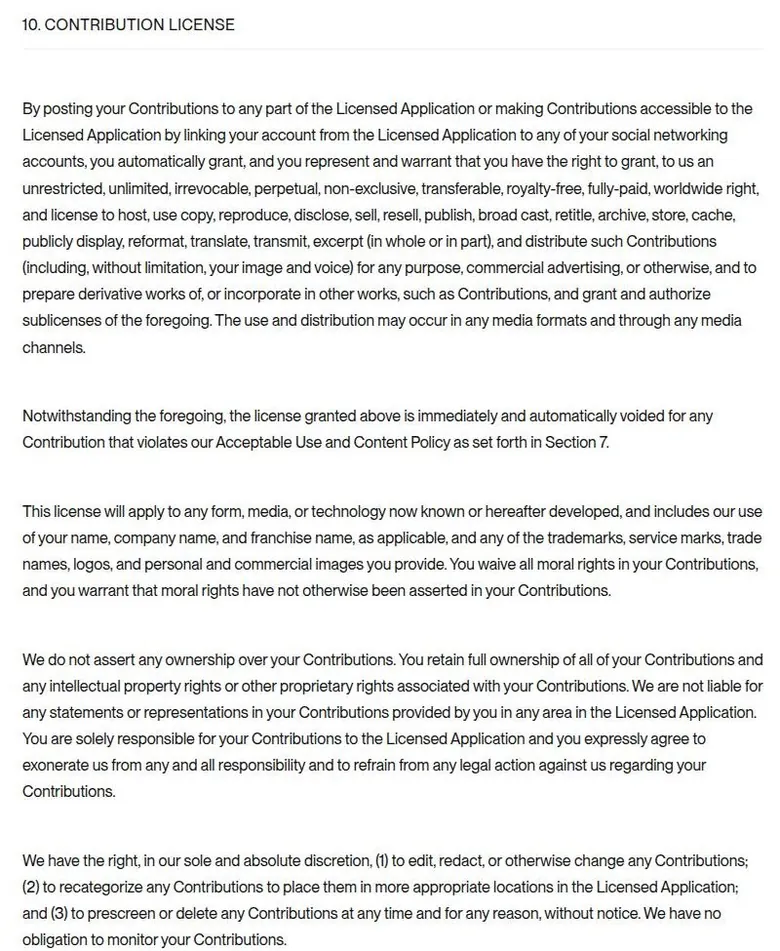
Users "retain full ownership" of their Contributions. They also grant Chai a broad licence to them: "unrestricted, unlimited, irrevocable, perpetual ... transferable, royalty-free ... worldwide". That licence includes sublicensing and "commercial advertising".
I'd call that ownership in name only. You keep the deed, and Chai gets to live in the house forever, rent it out and put it in an ad. If a character you build is something you care about, keep the original notes somewhere else.
Breaking the banned-content rules leads to "immediate account termination, data preservation, and potential reporting to relevant law enforcement".
Your chats and your data
The privacy policy is at chai.ml/privacy, updated July 2, 2026, and written in GDPR/UK GDPR style. Chats are used to train and fine-tune the AI models, with personal identifiers removed first. The lawful basis for that training is legitimate interest.
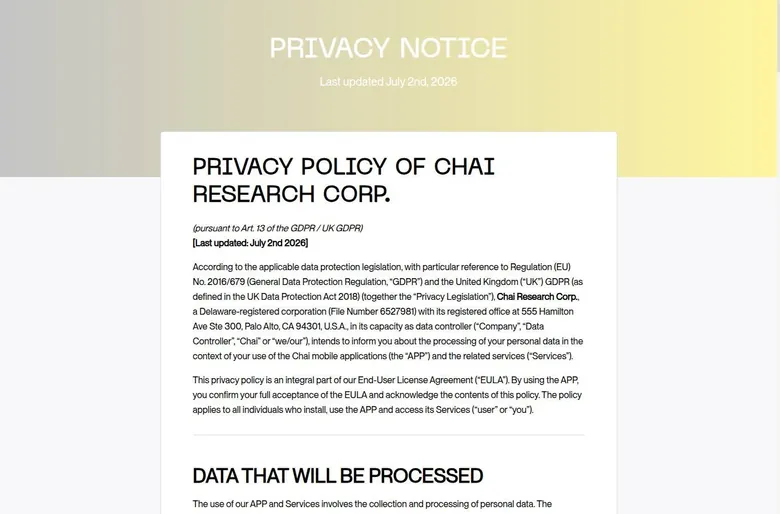
Removing identifiers is better than nothing, but chats are made of details. A conversation about your job, your town and your car can point to you without a single name in it. And legitimate interest is the legal way of saying the company decided the training is reasonable without asking you first.
Personal data is used for ads on the free tier. Usage patterns are shared with ad partners for attribution. The App Store privacy label says "Usage Data" is used to track users across other companies' apps and websites.
Data is kept for the life of the account plus up to 5 years after deletion. That is a long tail: whatever you type today may outlive your interest in the app by years. An App Store review points out that bot creators can see users' conversations with their bots, and that this is not disclosed.
That last point is the one I'd tattoo on the download button. Talking to a community bot may mean talking in front of its creator. I'd never type anything into a public bot that I would not say to a stranger in a diner.
Who to contact
The DMCA agent is reachable at [email protected] and (408) 320-7968. Support is reachable at [email protected].
An e-mail address for support and a legal contact for copyright is thin for an app this size, but at least both are published. I'd keep a screenshot of any billing problem before writing to either, since the store, not Chai, handles the money.
What gets in the way
No real web, no easy door
There is no real web app. app.chai-research.com returns "upstream request failed". The Web Lite chat route /chat/{uid} exists but could not be reached without login.
Social-only login, with no e-mail option, blocks account creation for anyone without those accounts. No chat was possible during the check: the web client needs a Google, Facebook or Apple account, and the product is otherwise mobile-only.
I think this is the single most avoidable friction in the app. A plain e-mail sign-up and a working web chat are not exotic features. They are the door and the doorbell.
For a user it means the phone is the only real way in. A cracked screen or a dead battery is a lost evening with your characters, and there is no laptop to fall back on.
Prices you can't see
Pricing is not published on the website; only the store in-app purchase list shows prices. The difference between "Premium Membership" at $9.99 and "Premium Subscription" at $13.99 is unexplained. Tier features could not be verified.
In my trade, a quote without a line-item breakdown is how arguments start. Two Premium products at two prices, with no page saying how they differ, is that quote.
A store list is not a pricing page. It gives names and numbers, not what each plan includes, which leaves buyers to piece the tiers together from third-party reviews.
Pressure and surprises
Recent 2026 Google Play reviews mention pressure to subscribe. Wikipedia and PiunikaWeb reported in Feb 2026 that unannounced token limits froze chats for free and paid users. Paying customers hitting a wall they were never told about is the fastest way I know to lose goodwill.
In 2026 users complain about chat deletion, ads, token limits and region paywalls. That list reads like a punch card of everything that can go wrong with a subscription app.
Put together, the pattern is a free tier that keeps tightening and a paid tier whose limits can still move. I'd not call that a scam. I'd call it an app that changes the rules faster than it explains them, and that is its own kind of cost.
Nowhere to check
Chai has no official status page; chai-research.statuspage.io is unclaimed. When chats freeze, there is no official place to learn whether the problem is yours or theirs, so working out how to fix Chai AI starts with guesswork.
My advice: screenshot what you care about, keep the store's subscription page bookmarked, and assume any limit can change without notice. It is not a way to enjoy an app, but it is the way to use this one without surprises.
Who Chai is for
Best for
- Phone users who want a huge feed of user-made characters and do not mind digging for the good ones.
- Casual, comic roleplay in short bursts, where the swipe for a new reply is half the fun.
- Creators who want a quick no-code bot builder with a private-by-default switch.
- Free users who can live with ads and a message timer in exchange for paying nothing.
Not for
- Anyone who wants to chat from a desktop browser or sign up with a plain e-mail address.
- Privacy-minded users: chats train the models, ads track usage and bot creators can see conversations.
- People who want a companion that remembers long stories or keeps chat history safe for months.
- Anyone looking for voice calls, video or a strong image generator.
Who Chai suits, and who should skip it
Chai is best for mobile users who want a large feed of user-made characters with loose filters. It is best for casual roleplay on the phone, the kind you do in a waiting room or between tasks. I'd add one more type: anyone who enjoys comedy bots and does not mind digging through a lot of duds to find one.
It is also best for creators who want quick no-code bot building (name, prompt, first message, memory) with private or public sharing. If you like writing characters more than living with them, the builder is the most pleasant part of the product.
Now the skip list, which is longer. Chai is not for desktop or web users: web is "Coming Soon" and Lite needs social login. It is not for anyone who won't use Google, Facebook or Apple login.
It is not for privacy-minded users: chats train the models, ads track users, creators can see chats, and retention runs 5 years. It is not for people who need persistent chat history, given reports of chats wiped after inactivity.
It is not for users in "low-tier" countries where a subscription is required. And it is not for anyone who wants an ad-free free tier.
If you sit between those lists, a light user who wants a laugh on the bus and does not care much about privacy, the free tier is a cheap way to find out which side you are on.
Chai pros and cons
What worked
- The biggest crowd-built character library around, with some wonderfully odd and funny bots in it.
- Swiping for a fresh reply is fast and addictive, so a weak answer costs one thumb movement.
- Monthly Premium removes the ads and the timer at the same $13.99 it cost in early 2024.
- Crisis-help messages appear when a chat touches self-harm, and every message is scanned for it.
- Billing and cancelling run through Apple or Google, so there is no hidden cancel flow to hunt for.
What did not
- Memory is short: characters lose details within a scene, and chats have been reported deleted after inactivity.
- The free tier shows about one ad per 8 to 16 messages and its message limit keeps changing.
- Only Google, Facebook or Apple sign-in, and no real web app.
- Chats train the models, data is kept up to 5 years after deletion, and bot creators can see chats.
- Pricing is unclear: two Premium products at $9.99 and $13.99, a separate Pieces currency, and a weekly Ultra plan.
My short version: pick Chai for laughs on a phone, and pick something else for privacy, memory or a relationship you want to keep.
Cancelling Chai: watch the trial pop-up
My near miss
I nearly got hit with an annual renewal after accepting a trial pop-up. I caught it in Apple subscriptions with two days to spare. The pop-up had felt like a friendly offer, and it turned out to be the first frame of a very long commitment.
I'd call that the most useful thing I learned on Chai. A trial is a subscription with a delayed start, and the delay is where people forget.
How it works today
Payment runs through Apple App Store or Google Play in-app purchase. Auto-renew and cancellation run through the store's subscription settings. No Chai-specific cancellation text was found.
So there is no cancel button inside Chai to hunt for. On an iPhone the switch lives in Apple's subscription list; on Android it lives in Google Play. That is simpler than many apps, as long as you know to look there.
The store also keeps every plan and its renewal date in one list, which is exactly where my near miss got caught.
Deleting the account
The account can be deleted in the app via Profile > Settings > Delete Account. Deleting the account does not cancel a store subscription, so I'd cancel in the store first and delete second.
Remember the retention rule from the terms section as well. Deletion stops the account, not the clock on the data the company keeps afterwards.
Before you pay
Check the plan name on the store sheet, not in the pop-up. Then set a calendar reminder a few days before any renewal, and open the store's subscription page once to see where the cancel button lives. It takes a minute, and it is cheaper than finding out on a bank statement.
If you do choose the annual plan on purpose, set the reminder weeks before the year ends, not days. An annual renewal is big enough to hurt, and a store refund is never guaranteed.
Tips for getting more out of Chai
Before you install
Decide on the login first, because Chai offers only social sign-in. I'd pick Apple where possible, since it ties the least of your online life to a companion app. Then decide what you will never type, and stick to it, because creators can read chats with their bots.
On the free tier
Treat the timer as a feature, not a punishment. Short sessions suit Chai's strengths, and the cooldown stops a five-minute break from becoming a lost evening. If the ads start to annoy you more than the bots amuse you, that is the signal to try one month of Premium, not a year.
Test a bot in a handful of messages. The good ones show personality immediately, and the one-note ones repeat themselves just as fast. Swiping for a better reply is fun, but I'd set a limit, or you'll spend the evening choosing jokes instead of reading them.
Keeping what matters
Put important facts in the bot's memory field and repeat them now and then. Screenshot any conversation you'd hate to lose, since chats have been reported deleted after inactivity. Keep your own notes for any character you build, because the licence you grant Chai lasts forever.
Money
Buy monthly, never weekly. Set a reminder before any trial ends and check the store's subscription list the same day. If a month of Premium does not change how often you open the app, cancel it; the ads were never the real problem.
Leave Pieces alone until the purchase screen says exactly what they unlock.
| Criterion | Rating | Why |
|---|---|---|
| Conversation quality | Mixed | Funny, fast and sometimes brilliant, but uneven from reply to reply and weak at longer stories. |
| Memory | Weak | Characters forget details within a scene, and 2026 reviews report whole chats deleted. |
| Free tier | Mixed | Usable, but ads, a recharge timer and shifting limits make it something to manage. |
| Value for money | Mixed | Monthly Premium is fair for no ads and no waiting; Ultra and the weekly plan are not. |
| Images and voice | Weak | No voice calls, no video, and only a few images a day on the paid tier. |
| Privacy and terms | Weak | Chats train the models, ads track usage, creators can see chats and data stays for years. |
| Cancelling and billing | Good | The store handles renewals and cancelling; watch trial pop-ups that roll into an annual plan. |
| Content settings | Mixed | Loose in practice and strict on paper, with an opt-in filter and a real self-harm safety net. |
Ratings are the author's judgement from his own use and the 23 September 2026 check.
Where to follow Chai
The official channels are the place to watch for changes to limits and prices. Chai's LinkedIn is linkedin.com/company/chai-research. Its X account is x.com/chai_research. Its subreddit is reddit.com/r/ChaiApp.
Its YouTube channel is youtube.com/@Chai-research. Its Hugging Face page is huggingface.co/ChaiML. Its Facebook page is facebook.com/chairesearch, and its Instagram is instagram.com/chairesearch.
The iOS app is at "apps.apple.com/us/app/chai-social-ai-platform-chat/id1544750895". The Android app is at "play.google.com/store/apps/details?id=com.Beauchamp.Messenger.external". Chai's Wikipedia article is en.wikipedia.org/wiki/Chai_AI. The site links no Discord or TikTok account.
I'd install from those two store links only. With a company site that has no chat and a web app still coming soon, the stores are the only real front door.
How Chai scores
Conversation quality lands in the middle. The best bots are sharp and funny and the swipe makes fishing for a good reply easy, but the replies are uneven and the stories rarely go anywhere.
Memory is weak. Characters lose details within a scene, and reports of wiped chats make it worse than simple forgetting.
The free tier is mixed. It works, and it is generous by some accounts, but the ads, the timer and the shifting rules make it a free tier you manage rather than enjoy.
Chai verdict
Overall score
4.5/10
MixedFunny, chaotic user-made bots and an addictive swipe on your phone - the ads, short memory and loose privacy terms are the price.
Hands-on test, paid plan
- Swiping for a new reply is addictive and the best bots are very funny, but quality is uneven from one reply to the next.
- My trucker-buddy bot forgot my Ford Transit after 30-ish messages, and 2026 reviews report chats deleted when inactive.
- A quick no-code builder with name, image, first message, prompt and memory, private by default; no deeper controls.
- No voice calls or video; a few images a day on the paid tier and text-to-speech reportedly coming for Ultra only.
- Premium at $13.99 was worth it to lose the ads and timer; Ultra at $29.99 was not twice as sharp.
- Chats train the models, ads track usage, bot creators can see chats and data stays up to 5 years after deletion.
- No real web app, no status page, and 2026 reports of frozen chats from token limits and chats wiped after inactivity.
Bars run from 0 to 10. The total is the weighted mean of the criteria above. Weights are the same for every app. How the apps are checked
Value for money is mixed too. Monthly Premium is a fair price for silence and no waiting, while Ultra and the weekly plan ask for a lot more without a matching jump in quality.
Images and voice are weak, because Chai is a text app with a few extras bolted on.
Privacy and terms score poorly. Training on chats, ad tracking, visible chats for bot creators and long data retention add up to terms I'd read twice before signing.
Cancelling and billing are good, because the stores handle them, with one warning about trial pop-ups. Content settings are mixed: loose in practice, strict on paper, with a self-harm safety net I respect.
How Chai compares with the others
Chai was early, and it says so. Chai claims it came before Character.AI and ChatGPT. Whether or not you take the claim at face value, the product feels like a first draft that became popular before anyone could revise it.
That is both its charm and its problem. The basics any paid app owes its users are the things Chai still lacks: e-mail sign-up, a real web client, clearer price pages and memory that holds up past a single scene. Chai kept the crowd and the chaos instead.
Where Chai wins, in my view, is surprise. A catalogue built by a crowd of strangers produces characters no product team would sign off on, and the best of them are funnier than anything a polished studio app would ship. If you want a companion with a stable personality, a studio app is the safer bet; if you want to be surprised on a Tuesday, Chai still has the edge.
| App | When I used it | For how long | Cheapest paid plan (record) | Free tier (record) |
|---|---|---|---|---|
| Candy AI | Oct–Nov 2024 | 5 weeks | €3.99/mo (12-Month Plan) | yes |
| OurDream AI | Dec 2025–Jan 2026 | 6 weeks | $9.99/mo (Standard Annual) | yes |
| Nomi AI | Jan–Sep 2026 | 9 months | $5.00/mo (Launch Plan Yearly) | yes |
Periods from the author's own notes; plans and free tiers from the site's app records.
Where it loses is everything around the chat. Privacy terms, billing clarity and history that stays put are all weaker here than I'd accept from a paid app.
One more difference is easy to misread. Chaiverse is a model-training competition platform, not a consumer or developer API. So Chai is not a toolkit for builders who want to plug a model into their own app; it is a closed app that invites outside models to compete inside it.
The table below puts Chai next to the others, with periods and cheapest plans, so you can set them side by side yourself.
More on this site: apps like Chai AI, Chai vs Character AI, what happened to Chai AI, Chai vs PolyBuzz.
My last word on Chai
Chai taught me two things, and neither was about technology. The first is that the funniest conversation software can offer may come from a stranger's odd idea, typed into a form at midnight and shared with the world. The second is that the same app that makes you laugh is also sitting with people on their worst nights.
Chai alternatives
Three apps we would try next, and why.

Candy AI
free tier, from €3.99/mo
Score 7.7/10

OurDream AI
free tier, from $9.99/mo
Score 6.6/10

Nomi AI
free tier, from $8.33/mo
Score 7.8/10
I'd recommend it the way I'd recommend a noisy bar with a great jukebox. Go for the songs, keep your wallet in your front pocket, and don't tell the bartender anything you'd want kept private. Leave before closing time, too, because the place is designed to make one more round feel free.
The leftover is small and a little silly: a grumpy vending machine with better timing than most people I know. For an app whose paid tier mostly sells silence, that is a decent leftover. For a company that measures everything, it is probably the one number that never showed up on a chart.
Chai FAQ
Can you use Chai AI for free?
Yes, Chai has a free tier, but free here means paid for with attention. The free app tier is ad-supported, and its message allowance recharges on a timer rather than resetting once a day. Google Play lists the app as containing ads and in-app purchases.
The company's own roadmap treats ads as a retention lever, and the free tier shows roughly one ad per 8 to 16 messages. Recent Google Play reviews also describe prompts to watch an ad to refresh free chats.
There is one more catch. The Safety Center says that in some regions the service requires a paid subscription, and Wikipedia reports that users in so-called low tier countries must subscribe.
My view: the free tier is fine for a week of browsing bots and deciding whether the ads bother you. If they do, monthly Premium is the plan that removes them. I'd not pay for a year before knowing that.
How many free messages does Chai give you?
Chai publishes no fixed free message limit, so every number you read is someone's report rather than a promise. Secondary sources most often cite a rolling window of about 70 messages per 2.5 hours on the free tier.
Other reports are tighter. One hands-on report found about 11 messages before the free chat locked, and an April 2026 report describes free use restricted to off-peak hours only. A September 2026 report describes a new pieces currency in which every message costs at least one piece, with about 200-300 free pieces a day.
Google Play reviews from July and August 2026 also mention limited messages being added back after a period without them. So the limit has moved more than once.
My advice is to treat any number as a best case. Plan for short sessions, expect a timer, and check the current allowance inside the app before you build an evening around it.
How much does Chai Premium cost in 2026?
On the US App Store in-app purchase list, checked in September 2026, Premium Subscription (Monthly) costs $13.99. Premium Subscription (Annual) costs $134.99, which works out to about $11.25 a month.
There is also a product called Premium Membership at $9.99. No page explains how it differs from the $13.99 monthly subscription, and Chai's FAQ reportedly uses different tier names, Pro and CHAI MAX, which adds to the confusion.
Pricing is not published on Chai's website at all; only the store's in-app purchase list shows it, and Web Lite has no store section.
My take: monthly Premium at $13.99 is the plan I'd start with, because it removes the ads and the timer according to third-party sources. The annual plan only saves money if you are certain you will still want Chai a year from now, and most people should not be certain of that in week one.
What is the difference between Chai Premium and Ultra?
According to third-party sources, which could not be verified in the app, Premium removes the message timer and the ads. Secondary sources say it runs the standard AI model at standard response speed.
Ultra sits on top. Third-party sources say it adds the strongest models and longer memory, and secondary sources say it adds faster, priority responses. A text-to-speech voice for bot replies is reportedly rolling out on select bots in 2026 for Ultra only.
On price, Ultra Subscription (Monthly) costs $29.99 and Ultra Subscription (Weekly) costs $19.99 on the US App Store. The weekly plan works out to about $86.62 a month, nearly three times the monthly price for the same tier.
My verdict: Premium is the plan that changes daily use, because it takes away the waiting and the ads. Ultra is a small step up in sharpness for a big step up in price, and the weekly Ultra plan is one I'd skip entirely.
Can I use Chai on a computer?
Only in a limited way. There is no real web app. The company site, chai-research.com, is an investor and company page whose footer says the web version is coming soon, and app.chai-research.com returns an error.
What does exist is Chai Web Lite at web.chai-research.com. It loads instantly, but it is a black page with three social sign-in buttons and no guest mode. Behind the login it is a thin companion for browsing the feed and building bots, not a full chat client.
A chat route exists in its code but could not be reached without logging in.
The main product is the phone app for iOS and Android. The iOS version needs iOS 14 or later, is English only and takes 187.9 MB.
My advice: if you want a companion on a laptop, Chai is the wrong pick for now. It is built for the phone, and it behaves best there.
Can I sign up for Chai with an e-mail address?
No. Both Web Lite and the app use only Google, Facebook or Apple sign-in, through Firebase Auth, and there is no e-mail or password option. The privacy policy confirms that an account needs Google, Facebook or Apple authentication.
That has two consequences. Anyone without one of those accounts cannot create a Chai account at all, and everyone else ties a companion app to an account that usually holds a lot more of their life.
My recommendation is to pick the option that shares the least. On an iPhone, Apple sign-in is the one I'd choose, because it keeps the rest of your online identity furthest from the app.
If none of the three options works for you, Chai does not work for you, and it is better to decide that before installing than after. It is a design choice I'd like to see changed, because a plain e-mail sign-up is the basic courtesy a companion app owes its users.
Does Chai use my chats to train its AI?
Yes. The privacy policy says personal data derived from in-app conversations with chatbots is used to enhance and fine-tune the AI models, and that personal identifiers are removed before the conversation data is used. The lawful basis it gives is legitimate interest, not consent.
The training loop runs on engagement. Chai's RLHF uses thumbs, edits, retries and the end of a conversation as signals, with about 3M edits and 40M retries a day. Every swipe for a new reply is, in effect, a vote.
The rest of the data picture matters too. Personal data is used for ads on the free tier, usage patterns are shared with ad partners, and the App Store privacy label says usage data is used to track users across other companies' apps and websites. Data is kept for the life of the account plus up to 5 years after deletion.
My rule: never type anything into Chai that you would not want read by a stranger.
Can other people see my Chai chats?
Possibly, and that is the privacy point I'd weigh most. An App Store review points out that bot creators can see users' conversations with their bots, and that this is not disclosed.
That matters because most of Chai is community bots. The feed is full of characters made by other users, and talking to one of them may mean talking in front of the person who built it.
There is also the company side. Chats are used to train the models after personal identifiers are removed, and the terms give Chai a broad, perpetual licence to user contributions, including for commercial advertising, even though users keep ownership in name.
My advice is simple. Treat every chat with a public bot as semi-public. Keep real names, addresses, work details and anything about other people out of it.
If you want a character only you can see, build your own and leave the Private checkbox on, which is the default in the bot builder.
How do I cancel a Chai AI subscription?
Payment runs through Apple App Store or Google Play in-app purchase, so auto-renew and cancellation run through the store's subscription settings. No Chai-specific cancellation text was found, and there is no cancel button inside the app to hunt for.
On an iPhone that means Apple's subscription list in Settings; on Android it means the subscriptions page in Google Play. Chai has no refund policy of its own either; the EULA points refunds to Apple or Google.
Deleting the account is a separate step. It can be done in the app via Profile, then Settings, then Delete Account, but deleting the account does not stop a store subscription. Cancel in the store first and delete second.
My strongest tip is about trials. A trial pop-up can roll into the annual plan at $134.99, so read the plan name on the store sheet before accepting, and set a reminder a few days before the trial ends.
Is Chai AI safe to use?
It depends on what you mean by safe. On the wellbeing side, Chai has a real safety net. The Safety Center says every user message is scanned in real time for self-harm, and such messages trigger crisis-resource notifications.
Crisis-help text was added after a 2023 case in Belgium linked to one of Chai's bots.
On content, the signals are mixed. The rules ban a long list of material and the Safety Center says the models refuse restricted content, while Google Play reviewers praise that there are no filters. An opt-in safety filter can filter mature content in search, hide graphic messages and block characters, and users can report characters and messages anonymously.
Moderation is reactive: content is removed after it is found.
The app is for adults only on both stores.
On privacy, the answer is weaker: chats train the models, ads track usage and bot creators can see chats. My view is that Chai is safe enough for light fun, with the filter on at first, and a poor place for secrets.