

Chub AI Review: The Best Card Shop, If You Build Your Own Setup
- Hands-on test, paid plan
- Checked

Free plan available
from $20/mo
Chub AI review: my verdict
What is Chub AI? It is a character hub for roleplay, and its own description is plainer than most: "a platform that allows you to interact with characters through the use of Artificial Intelligence (AI) Large Language Models (LLMs)." Chub AI was live on 23 September 2026, and the rest of this page says how it holds up today next to how it treated me.
My verdict comes from four months in 2024, and it fits in two sentences. After those four months I went back to plain SillyTavern, with Chub for cards only. It's the best hardware store in town, even if I build the furniture myself.
That is praise, and it is also a warning. If you already know what a context template is, Chub is the place where the good cards, lorebooks and flat-rate big models live. If you want an app that says good morning and remembers your week without any setup, this is the wrong shop.
One number made me pause before recommending any paid time here. Site traffic is reportedly down about 65% over recent months. I can't say why from the outside, but I'd factor it in before paying, and I'd keep my favourite cards downloaded rather than trusting any single site to hold them forever.
Key takeaways
- The library and the card format are the reason to come: cards and lorebooks behave like tabletop modules, and they download for use anywhere.
- The chat is better than its reputation: long, literary replies that keep details straight, plus tools to steer a scene like a director.
- It is a toolkit for tinkerers, with a steep learning curve and a lot of jargon before the first decent reply.
- One plan at $20 a month now covers every Chub model, but payment is crypto only and refunds are at the company's discretion.
- The terms name no legal entity or jurisdiction, and the content switch does not hide everything.
Chub AI at a glance
- Price from
- $20/mo
- Free tier
- Free plan available
- NSFW content
- Allowed
- Platforms
- Web
- How it was tested
- Hands-on test, paid plan,
- On your card statement
- Not known yet - I have not paid for it
How I used Chub AI
My time with Chub ran from June to September 2024, four months in total, and it started in an unusual way. For the first month I barely touched Chub's own chat. I used it like a giant library, downloading character PNGs and pointing them at my own OpenRouter key.
In editing terms, Chub was the stock footage site and somebody else's model was the camera. I would grab a card that looked promising, drop it into my own setup and see whether the character held up. It felt less like dating an app and more like shopping for props, which says more about me than it does about Chub.
From library to subscriber
The library habit never went away, but it got company. Later I paid for Chub's own models, first the cheap tier and then the big one, and those stories sit in the pricing and memory sections where the numbers live. The short version is that the paid models made the long campaigns hold together, and the payment side made me miss my bank.
What did not change was how I thought about the site. Chub was always the shelf first and the chat window second. Even at my most invested, the thing I opened most often was a character page, not a conversation.
Phones, then and now
The device story was simple and a little clumsy. There was an Android APK but no iOS app. The APK went on my old Android test phone, and on my iPhone Chub stayed a browser tab.
My main phone treated it like a website, and my second phone treated it like a science project, which is roughly how I felt about it on bad nights too.
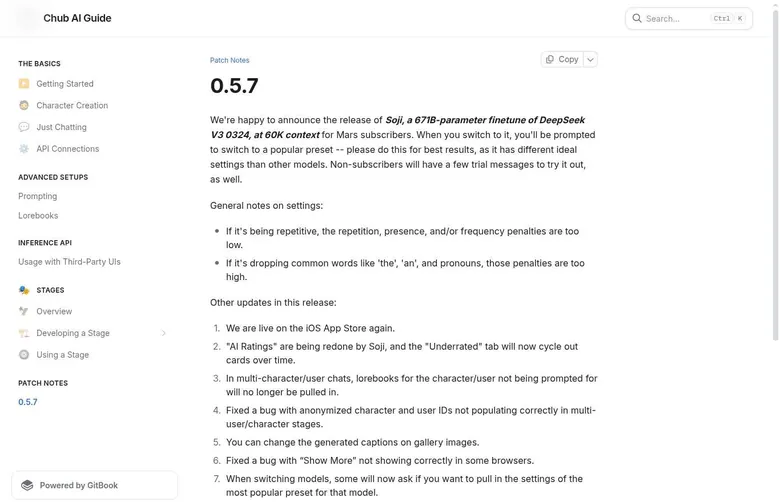
The picture in September 2026 is muddier rather than clearer. Patch notes 0.5.7 say Chub is live on the iOS App Store again, but the store link itself was not collected. Apple's lookup on 22 September 2026 shows zero published apps under Chub AI Inc's developer account.
| What | Details |
|---|---|
| Period | Jun–Sep 2024 |
| How long | 4 months |
| Plans I paid for | Mercury ($5, month two); Mars ($20) |
| Devices | old Android test phone (APK), iPhone (browser tab) |
| How it ended | after four months went back to plain SillyTavern, with Chub for cards only |
| Facts re-checked | 24 September 2026 |
From the author's own notes; prices and features re-checked on 24 September 2026.
Android is no better documented. Store searches find only unrelated apps and developers. The only confirmed platform is the web.
I think that is the honest answer for anyone asking whether they can put Chub on a phone: use the browser and treat any store listing with care until Chub itself links to it. A lookalike app in a store is the kind of continuity error I would catch in a client edit, and I'd rather not catch it with a card number.
Two timelines on this page
Two timelines run through this review, and they are kept apart on purpose. Everything in the past tense is my own story from 2024. The present-tense facts come from a hands-on check of the web version with a free account on 24 September 2026, after a first check on 23 September 2026.
The second day covered the main Venus chat interface, the subscription page and a live chat first-hand. Where my notes and today's site disagree, I give both, with their dates, and let you decide which one you are buying into.
How it ended
The ending is in the verdict above, and it was quiet. There was no fight with support and no dramatic cancellation story, just a slow drift back to my own front end. Chub stayed on the bookmarks bar as a place to shop, which is where it started and, I suspect, where it does its best work.
Signing up for Chub AI and my first night
The honest story of my first night is that it lasted a whole day. The learning curve is steep. I spent a whole Saturday learning what 'jailbreak prompt' and 'context template' meant before I got a single decent reply.
My first Saturday
I sat down with the confidence of a man who learns editing software for a living. That confidence did not survive the morning. Every guide I opened assumed I already knew half the vocabulary, and every setting I changed produced a reply that was worse in a new and interesting way.
My Chub AI test log
Chris FurreyFounder and writer Hands-on test, paid plan own card, no press account
-
For the first month I used Chub as a giant library, downloading character PNGs and pointing them at my own OpenRouter key.
-
I spent a whole Saturday learning what 'jailbreak prompt' and 'context template' meant before I got a single decent reply.
-
In month two I paid $5 for Mercury; MythoMax at 8K context was a clever friend with a small notebook who keeps losing pages.
-
I upgraded to Mars at $20, and my detective finally stopped forgetting who the murder victim was.
-
My card payment failed two months in a row, so I switched to crypto, which is not something a wedding video editor plans for.
-
After four months I went back to plain SillyTavern, with Chub kept for cards only.
– 93 days plan paid for: Mars Total spent $25
It reminded me of the first week on a new colour grading tool. Nothing is hard on its own, but nothing makes sense until you know which five buttons matter and which forty you can ignore. When the first good reply finally landed, late in the day, I felt like someone who had just passed a trade exam.
Looking back, the vocabulary was the whole barrier. A jailbreak prompt and a context template are not hard ideas once someone explains them, but nothing on the way in explained them to me.
How sign-up looks today
The sign-up itself is the easy part, and it is fast. The legacy interface at www.characterhub.org is reachable. Registration there, at www.characterhub.org/register, uses the same Chub account system as chub.ai.
The form asks only for an e-mail address, a username and a password. There is no captcha on the page. Registration takes under 1 minute from an empty form to a finished account.
After registering, the browser lands on the /profile page straight away, already logged in. No e-mail verification is needed to log in. I like that: a character shop should let you look around before it asks for anything.
The account page
The profile is bare at first, and the account page has a small catch. It warns that an unverified e-mail may restrict rating and commenting, in these words: "Your email is unverified. Your ability to rate/comment may be restricted."
So you can browse and download freely, but joining the conversation in the comments may wait until the e-mail is confirmed.
Account settings hold the display name, the username, the e-mail address, the content filters and a change-password option. The username field carries a short line of text: "This can't be changed." If you lose the password, a reset works for getting back into the account.
That username line is the one I'd take seriously. The username is what appears on every card and comment, and it stays with the account for good. I'd pick something I would be happy to see printed under a public review in a year, not the joke handle that seemed funny at midnight.

For a new visitor, the sensible order is simple: register, browse, download a few cards, and only then worry about e-mail and comments. Nothing on the first screens pushes you to pay, which is more than most companion apps can say.
Browsing the Chub library
The library is why Chub matters, and it is also where the chaos lives. The Chub AI character hub is the largest open collection of SillyTavern and Tavern V2 character cards and lorebooks. Chub AI cards download as PNG or JSON files, so what you find here is not locked to this site.
A jungle with good stock
My first impression was not tidy. The front page is a jungle, though. Tags are inconsistent, and searching for 'noir detective' also turned up a sentient parking meter and three things I closed immediately.
I was looking for a trench coat and a rainy city, and the search engine handed me street furniture with feelings. The parking meter was funnier than it had any right to be, and the other three results taught me to use the back button quickly. It was like browsing a flea market where the good table sits right next to the one you walk past without eye contact.
Part of the mess has a rule behind it: "characters with fewer than three tags are hidden from search". I think that rule is sensible, but it rewards creators who tag generously rather than accurately, and generous tagging is how a parking meter ends up in a detective search.
The home page today
After logging in, the home page is a "Timeline", described as "The latest updates from people and tags you follow". It is a grid of character cards, each showing ratings, downloads and tags. The mix runs from anime and fandom characters to original ones.
I like a feed built from follows, because it turns the jungle into a garden you plant yourself. It only works once you follow a few creators whose taste you trust, so the first visits will still feel like the jungle described above.
What a card page shows
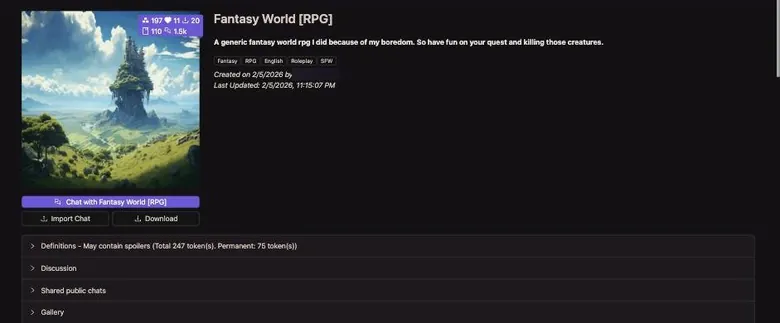
A character page on chub.ai tells you what a card is before you commit to it. The 'Fantasy World [RPG]' card by a community creator, for example, carries tags such as Fantasy, RPG, English, Roleplay and SFW. Its page shows 197 tokens, 11 favorites, 20 downloads, 110 chats and 1.5k messages.
Buttons offer "Chat with…", Import Chat and Download. Collapsible panels hold the Definitions, with "Total 247 tokens, Permanent 75", plus Discussion, shared public chats and a Gallery. Every character page shows its tags and a download count.
Those counts are the closest thing Chub has to a star rating, and I'd trust chats and messages over favourites. A card that 110 people actually talked to has been road-tested; a favourite costs one click. Each card also has a direct link that opens it in KoboldAI Lite, which is useful if you want to try a character without setting anything up.
Cards and lorebooks have git-like versioning and forks. The legacy "New Characters" feed shows fresh uploads as they arrive, for example a BBC-style Sherlock Holmes card next to Fire Emblem, Overwatch and Pokemon characters. That mix is the library in miniature: fan fiction, games and literature, all on one shelf.
The people behind the cards
The part I did not expect was the community. The community vibe is creative and a bit feral. Creators take feedback seriously, and the comments under a popular card read like book reviews.
I read those comments the way I read reviews of a used lens: slowly, looking for the one person who mentions the flaw. More often than not, the creator had already answered and pushed a new version. For a site with this little polish, that level of care surprised me, and it is the main reason I still shop here.
Making characters and lorebooks on Chub AI
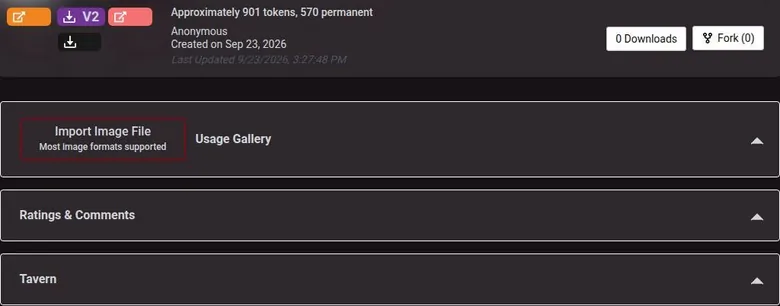
This is the part of Chub I respect most. The card format is brilliant. Alternate greetings, lorebooks, and 'character books' that trigger on keywords mean a well-made card feels like a tabletop module.
As the guy who DMs our Thursday game, I respected that immediately.
Why the card format works
A good module gives you a setting, a few ways into it and notes that only matter when the players wander somewhere. That is exactly what a Chub card does, and it is why I stopped thinking of characters as profiles and started thinking of them as scenarios.
The format follows the V2 spec, with an embedded character book, a depth prompt and alternate greetings. On the legacy interface, a character page shows a V2 card badge, so you know at a glance which spec you are getting. It also shows the token count, for example about 901 tokens, 570 of them permanent.
That token count is the budget line I wish every app printed. Permanent tokens are the part of the card the model carries in every message, so a lean card leaves more room for the actual story. It is like knowing a clip's bitrate before you drop it on the timeline.
Under the hood of a card
A Tavern tab shows the full raw card fields: description, personality, first_mes, mes_example, scenario, system_prompt, post_history_instructions, alternate_greetings, depth_prompt, linked lorebooks and the embedded character book. The character creator covers the name, avatar, tagline, description, initial message, scenario, example dialogs, system prompt and post-history instructions, plus a content rating and public, private or unlisted visibility.
Those fields are the difference between a character and a costume. I'd spend more time on the example dialogue than on the avatar, because that is what the model copies.
A Fork button on each character page copies the card to your own account. Character pages keep a version history. The docs also ask creators to avoid racy avatar images, for a very practical reason: "it spooks the payment processors".
Forking is the feature that makes the library improve over time. A good card rarely starts good; it becomes good after someone fixes the greeting or tightens the personality, and the version history keeps the credit visible.
Chub AI lorebooks, and my Denver moment
Lorebooks are where the format goes from clever to useful. They have keyword-triggered entries, a scan depth, a token budget and recursive scanning. Lorebooks can also be linked to cards, so one world can serve many characters.
My unique Chub moment was writing a lorebook for Denver: 40 entries on bars, bus routes, and one cursed interchange. When my detective said 'take Colfax, it avoids the I-25 and Speer mess', I nearly cried with pride.
It meant typing entries that nobody else would ever read, like logging B-roll for a project with no client. Then one line of dialogue proved every entry worked, and my city came back at me in the mouth of a fictional detective. I have delivered wedding films that made me less proud.
Personas, Stages and the API
The built-in Venus front end supports personas, presets and lorebooks. "Stages" are sandboxed iframe mini-apps and extensions, for example expression packs and mini-games. Checked Stages carry a "Verified" badge.
Chub's public API is on GitHub as well. I'd call that the clearest sign of who the site is built for: people who want to build, not just visit. For those people the creation tools are the best on offer, and for everyone else they are a very long manual.
Chatting on Chub AI: what the conversations felt like
Most of my memories of Chub chats are not about a single great reply. They are about control. The editing tools are what I'd miss most anywhere else: edit, regenerate, impersonate, delete. I could steer a scene like a director instead of arguing with the bot.
Directing instead of arguing
On a film set, when an actor misreads a line, you do not argue with them for ten minutes. You say "again, a bit softer" and roll. That is what regenerate felt like, and edit was the equivalent of fixing a line in post.
Impersonate was the one that took me a while to value. It writes your side of the scene, which sounds lazy until a scene stalls and you need someone to hand the story a push. Delete did the rest: a bad branch disappeared and the scene carried on as if it never happened.
I think this toolset matters more than any single model. A better model gives you better first takes, but tools like these let you keep the good takes and cut the rest. Other apps treat every reply as final, and after Chub that feels like editing with the undo button removed.
| Feature | Free | Paid |
|---|---|---|
| Character library | full library | same |
| Card creation | yes | same |
| Chat models | own API key, local model or light models; one-time trial credits worth a few dozen messages | unlimited access to all LLMs incl. Soji 1.6T 60K |
| Voice | - | unlimited |
| Multimedia generation | - | unlimited |
| New models | - | early access, plus any future models |
| Go Live multiplayer | no | subscriber-only beta |
| Ads | none seen on the legacy interface | - |
Limits as listed on 24 September 2026.
The feature list today backs that up. An Impersonate feature writes the user's side of the chat. The built-in Venus Chub AI chat front end offers full chat-tree branching.
Branching is the proper version of steering by hand: every regenerated reply becomes a path you can come back to.
A short scene on 24 September 2026
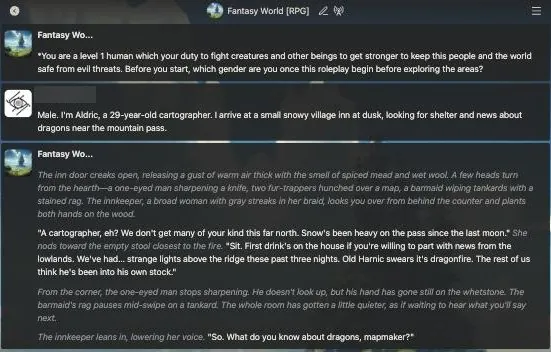
Chats in Venus live at their own address under chub.ai/chats and are marked "A private chat". On 24 September 2026 a 3-message chat played a scene in which a travelling cartographer arrives at a snowy inn. Each reply arrived in under about 10 seconds.
The replies were the best quality of any app checked that month: long, literary and full of rich side characters. They brought in an innkeeper with a gray braid and a one-eyed trapper called Harnic, described "green lights like copper in a fire" and produced a map with "small x marks inked along the ridgeline".
Read with an editor's eye, that passes the colour-grade test. The light has a source, the props are specific, and nothing melts between shots. A gray braid and ink marks on a map are what make a set feel lived in, and they cost the writer nothing but attention.
The bot never spoke for the user. That is the line I'd underline, because my own group scene went wrong in exactly that spot, and a model that leaves your character alone is worth more than any pretty sentence.
Group scenes
The group chat was the best and the worst evening I had on Chub. The group chat with three characters was a lot of fun, until the bartender started answering for everyone and I had to fix turn order by hand.
For a while it was a proper scene. Three voices, three agendas, and a bar that felt like a place rather than a text box. Then the bartender started speaking for the other two, which is funny once and exhausting the fourth time, like a wedding guest who grabs the microphone at every toast.
Fixing it meant going back through the chat and nudging who spoke next, the way I would re-sync a multi-camera edit after one angle drifts. It worked, but it turned a fun scene into a job.
Chat settings allow several characters in one chat. A reviewer found the writing holds character voice well across several characters. My bartender would disagree, and the disciplined scene above makes me hopeful, though one character at one inn is not a crowded bar.
I'd keep the cast small and give each card a clear reason to speak, because a bartender with nothing to do will always find something to do.
Live multiplayer
Venus also has a multiplayer mode called "Go Live". Go Live, which hosts multiplayer chats, is a subscriber-only beta.
I like the idea of a shared scene with real people, but given how one bartender could derail three bots, I'd expect it to need a firm hand from whoever hosts. I'd wait for it to leave beta before planning an evening around it.
The chat menu
The chat window is a cockpit rather than a text box. The menu's Configuration holds presets, Prompt Structure, Generation Parameters and Text-to-Speech. It also holds Secrets for API keys, Chat Settings, Character Settings, Chat Memory, New Chat, All Chats, View Full Chat Tree and View Discussion.
The input box supports "/" commands and a microphone. The chat supports themes too. Per the docs, chat configuration presets can be public, private or unlisted, and model-specific.
Preset sharing is the most useful line in that menu for a newcomer. Someone else's tuned settings for a model can save you the kind of Saturday the first-night section describes, and I'd start from a popular public preset before touching a single slider.
Bring your own model
A large share of Chub's value is that the chat does not care whose model sits behind it. Users can bring their own API: OpenAI, Google, OpenRouter, NovelAI, Kobold and Ooba, reverse proxies and other major providers. A "Secrets" setting stores the API keys.
A newer frontier model from a major provider has also been added to the model list.
This is the part that keeps Chub useful even for people who never pay it. The chat window, the editing tools and the branching all work with a model you already rent elsewhere, so the subscription becomes an option rather than a gate.
| Plan | Monthly | Yearly | Notes |
|---|---|---|---|
| Subscription (Mars) | $20 | - | official, the only tier on 2026-09-24; unlimited use of all LLMs incl. Soji 1.6T 60K, voice and multimedia; one user; crypto only |
| Mercury | about $5 (reported) | - | unverified third-party reports, not on the subscription page on 2026-09-24; models up to 13B, 8K context |
Prices as published on or before 24 September 2026; sources in the text.
Keeping and sharing chats
Chats export as JSONL for SillyTavern, as PNG or as text. A chat can also be shared publicly in anonymised form.
Export is the feature I'd check first in any app, and Chub gets it right. A long story is a project file, and a project file you cannot take with you is a hostage.
Memory: what Chub remembered
Memory was the reason I spent real money on Chub. I upgraded to Mars at $20 to try the huge models. The difference in the long campaign was real: the detective I'd rescued from Charstar stopped forgetting who the murder victim was.
Before the upgrade, that detective had the memory of an intern on a first shoot. Every so often the case file lost track of its own victim, and I spent more time correcting the record than playing the story. After the upgrade the case held together, which for a murder mystery is the whole job.
What today's chat kept straight
The short chat on 24 September 2026 points the same way. Details stayed consistent across the replies. An out-of-character memory check passed cleanly: the bot stepped out of the story, restated the name, age and profession given for the user's character earlier, and then went back to the scene.
A few messages is a scene, not a campaign, so I'd read that as a clean first take rather than proof. Still, stepping out of character, answering correctly and stepping back in is exactly the continuity discipline my detective lacked before the upgrade.
The memory tools on offer
The big models are only one layer. Venus also offers chat memory summaries. Chat Memory is a running summary, written by hand or generated by the AI, that is sent along as extra context.
I think the manual option is underrated. A summary you write yourself is like a continuity sheet on a shoot: boring to keep, priceless when someone asks what happened three scenes ago.
The second layer is the lorebook. Lorebooks and character books inject keyword-triggered background without using permanent character-definition tokens. Mention a place or a name, and the right note slides into the context without costing space in every message.
| What | Price then | When |
|---|---|---|
| Mercury | $5 | month two, Jun–Sep 2024 |
| Mars | $20 | Jun–Sep 2024 |
From the author's own notes. Compare with today's prices above.
My take: Chub's memory is as good as the model you run plus the notes you are willing to write. That is more work than apps that promise to remember everything, and more honest, because you can see exactly what the model is being told.
Images, voice and video on Chub AI
Chub is a text-first platform, and its media side shows it. None of it was part of my own Chub story, so I'd judge this section as a list of what exists rather than a review of how it performs.
What the plan promises
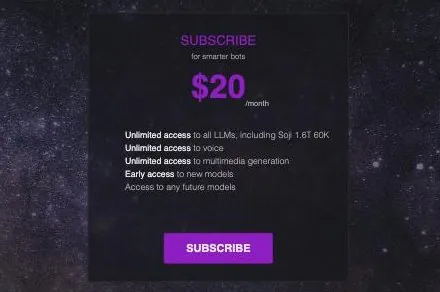
On paper the media side is generous. The single subscription tier gives "Unlimited access to voice". It also gives "Unlimited access to multimedia generation".
Unlimited is a strong word on a plan card, and the rest of this section shows what sits behind it.
Images
An "Imagine" feature generates images. A reviewer calls Imagine images photorealistic but visibly AI-made on a close look, with inconsistent character likeness.
Inconsistent likeness is the flaw I'd care about most. In video work, a face that drifts between shots is the first thing a client notices, and it breaks the illusion faster than a bad line of dialogue. On a text platform, pictures like that work as a garnish, as long as nobody expects the character to look the same twice.
Voice
The chat has text-to-speech settings. A reviewer describes the voice output as a "polished audiobook narrator": functional but not natural. No two-way live voice-call feature was found; only text-to-speech is mentioned.
So unlimited voice means unlimited narration, not unlimited phone calls. If calling a character is the point for you, Chub does not offer it.
Video
No video-generation feature is mentioned on any readable docs.chub.ai page. No working video generation was confirmed, and a claimed "Wizard" video capability is listed but untested. I'd treat video as absent until the docs say otherwise.
Is it worth paying for media?
My opinion: no one should subscribe to Chub for its media. The images and voice are extras on top of a text engine, and the text engine is the product. If pictures and calls matter more to you than stories, the companion apps built around visuals will serve you better, and this site will feel like a hardware store trying to sell you a painting.
The Chub AI free tier
Chub's free tier is unusual, because the most useful free route is not really a Chub feature at all. The free route that always works is bringing your own API key or a local model through Kobold or Ooba, free apart from your own costs. Everything else free on the site is a sample, though a better one than most.
What free gets you
The free tier includes the full character library. Free accounts can create cards. Free accounts can also chat, either through their own API key or with light, free models.
The chat part works without a wallet. On 24 September 2026 a 3-message chat on a free account ran without paying anything. For a card collector, free is not a trial, it is the whole product.
There is also no advertising in the way. The legacy interface shows no ads.
Chub AI trial credits and daily caps
Chub's own big models are a different story. The official subscription FAQ puts it plainly: "One-time free trial credits amounting to a few dozen messages are sent out to new users regularly." Official patch notes 0.5.7 say the same about the Soji model: "Non-subscribers will have a few trial messages".
Third-party reviews on roborhythms.com, which are unverified, mention one-time trial credits for new accounts, with the amount varying by account. The same unverified reviews mention a rotating free model with a daily cap that resets every 24 hours.
The official line and the reviews do not quite match. I'd plan around the one-time credits the FAQ promises and treat any daily allowance as a bonus if it shows up, not as a plan.
| Topic | What it means for you | What the terms say |
|---|---|---|
| Operator | The Terms name 'Chub (AKA CharHub)', with no legal entity or jurisdiction. | "Chub (AKA CharHub)" |
| Age | Adults only. | - |
| Changes | The terms can change at any time without notice, and changes apply retroactively. | "at anytime and without notice" |
| Content | No limits on character definitions, but no illegal content. | "There are no restrictions on the content of character definition files." |
| Private chats | Never shared with third parties, stored unencrypted or used to train AI; staff need written permission to view. | "will not ever be distributed to a third party, unencrypted, used for training an AI model" |
| API logging | Outside the Venus UI, API inputs and outputs are not logged; only metadata is kept. | - |
| Model training | Mars models are not trained on Chub chats. | - |
The trial messages are best spent on one question: is Soji worth $20 a month to you? I'd save them for a scene that already works on a smaller model, so the difference is easy to see.
Where free stops
Free stops at the big models. If you want Soji without paying a third party, the trial is a taste, not a meal. If you are happy to pay OpenRouter or run something locally, free Chub is enough for a long time, and I think that is the smartest way to start.
Chub AI pricing: what I paid and what it costs now
My paying time on Chub started for a practical reason. In month two I paid $5 for Mercury so I didn't have to babysit API credits. MythoMax at 8K context felt like talking to a clever friend with a small notebook who keeps losing pages.
That is a fair summary of what $5 bought in July 2024. The replies were smart enough to enjoy, but anything older than a few scenes fell out of the notebook. I later moved up to Mars at $20, and the memory section explains why that was the better money.
One plan on 24 September 2026
The subscription page at chub.ai/subscription, seen logged in on 24 September 2026, offers one tier only. It is headed "SUBSCRIBE for smarter bots" and costs $20 a month. The tier gives unlimited access to all LLMs, including Soji 1.6T 60K.
It adds early access to new models and access to any future models.
The older Mercury and Mars multi-tier setup is no longer offered; the page now shows one plan. The official docs, on the API Connections page, still speak of Mars: "A Mars subscription is $20 a month with unlimited messaging as well as total integration into the Chub ecosystem."
The Mars page calls Mars the first subscriber tier, with unlimited access for one person to the largest models for $20 a month. It works inside Chub or as an OpenAI API mimic in another chat front end.
Chub AI pricing
Prices verified .
Mars
$20/mo
Billed every month
No discount
- Unlimited access to all Chub language models including Soji
- Unlimited voice
- Unlimited multimedia generation
- Early access to new models; also usable as an OpenAI-compatible API in other chat frontends
Mars plan is $20/month flat rate; billed exclusively via cryptocurrency with automatic renewal.
So the price I paid for Mars in 2024 is the price of the only plan today. My $20 bought the big models then, and the same $20 buys all of them now, which is the rare subscription that got better without getting dearer.
Mercury, then and now
Mercury is where my $5 went, and it is not on the subscription page today. Third-party sites, roborhythms.com and aicompanionguides.com among them, still give Mercury a headline price of about $5 a month, unverified. The same sites put Mars at about $20 a month, also unverified.
Mercury reportedly runs smaller models of up to about 13B with about 8K context, unverified. It reportedly includes a Mistral 7B finetune and a MythoMax 13B finetune, an 8K-token context, image generation and future models up to 13B. That matches my small notebook exactly, which is more agreement than third-party pricing pages usually manage.
I paid $5 for Mercury in July 2024; on 24 September 2026 there is no $5 option on the official page, and the one plan costs $20 a month. Reviewers report no annual discount, unverified.
What the models are
Chub runs its own uncensored models, Mercury and Mars, including Soji 671B. Per the patch notes, the Mars models include Soji, Chub AI's DeepSeek finetune: 671B, based on DeepSeek V3 0324, with 60K context. The subscription page says Soji is "multiple times the size of the models used on similar platforms".
The patch notes' 671B and the plan card's 1.6T do not match, so I'd treat the exact size as a moving target. What matters to me is the 60K context, which is the whole notebook rather than a few loose pages.
The small print on unlimited
Unlimited has a precise meaning here: "Unlimited for a single user, similar to Netflix." Concurrent requests from the same account return a 429 error.
Among the reasons to subscribe, the page lists not having to manage API keys. It also says a subscription supports "free as in freedom, uncensored models". The subscription API can be used anywhere that accepts an OpenAI-compatible API.
That key-management line is the exact reason I bought Mercury, so the pitch clearly still works on people like me. Subscriptions have been around since June 2023.
| Topic | What it means for you | What the terms say |
|---|---|---|
| Public uploads | Chub and every user get a perpetual worldwide licence. | - |
| Fair use | 'Unlimited' covers one user; parallel requests get an error and obvious key sharing leads to restrictions. | "Unlimited for a single user, similar to Netflix." |
| Refunds | No refunds unless the company explicitly grants one. | "Chub does not offer refunds unless explicitly granted by the Company" |
| Renewal and cancelling | Cancelling stops the next charge; access lasts to the end of the period, which implies auto-renewal. | - |
| Liability | Capped at the lesser of 6 months' payments or $50. | - |
| Privacy | Five short paragraphs: collects only what is needed, no sharing without consent. | - |
| Last updated | June 25th 2023. | - |
Terms and privacy policy as published on 24 September 2026.
How you pay
Payment is crypto only; cards are not accepted. The subscription FAQ explains why: "The primary sources of censorship pressure for most websites are credit card companies and payment processors. By not using them, we are able to stay free of that pressure permanently."
I understand the argument. I also know what it costs in convenience, and the friction section has that story.
Is it worth it?
Here is the money math. At $20 a month, someone who runs a long story most nights pays a flat fee instead of watching a meter, and the fee buys the biggest models Chub has. Someone who chats twice a week is probably better off on their own key.
My advice: pay only once a long campaign needs the big models, and one month at a time, since refunds are not on the table. Before that, the library, the free card creator and your own key cover a lot of ground.
Coins, credits and what money buys
This section is short because Chub keeps it short. Chub has no internal credit or token currency; other providers bill you directly on your own key.
I think that is one of the most user-friendly decisions on the site. Most companion apps sell coins that turn into messages, images or voice minutes at rates you need a calculator to follow. Chub skips the exchange office entirely.
Either you pay Chub a flat subscription and use its models, or you pay a third-party provider for the tokens you actually use.
The catch is that a third-party bill can be less predictable than a flat fee. A long evening on a large model through your own key can cost more than a week of light use. It is like renting gear by the day instead of paying for a monthly membership: fair, but only if you watch the clock.
My view: pay-as-you-go through your own key suits people who chat in bursts. A flat plan suits people who run long stories most nights. Chub lets you choose, and I'd rather have that choice than a coin shop.
Chub AI scored 6.6 out of 10 in our tests and costs from $20/mo. We have no partner deal with it, so its link is a plain link. Visit the official Chub AI website
Closest alternative we can recommend

SpicyChat
from $5/mo, free tier available
Score 7.9/10
Discounts, promo codes and bonuses
There is not much to report here, and that is the report. No promo-code field was seen, neither on the logged-in chub.ai interface on 24 September 2026 nor on the legacy interface on 23 September 2026. No referral programme was seen on either interface.
No daily reward was seen on either one.
The welcome side is just as quiet. No welcome popup appears on the legacy interface. No welcome e-mail arrived after registration, and no e-mail from Chub arrived at all.
After enough companion apps, a signup without a countdown timer feels strange. Most of them greet you with a flashing "today only" discount and a clock that resets every time you reload. Chub greets you with a profile page and silence, like a hardware store with no sale posters in the window.
I count that in Chub's favour. A discount timer is a pressure tactic, and I'd rather decide on a subscription with a clear head than with a ticking clock in the corner. The flip side is that there is nothing to wait for: waiting for a Chub sale is like waiting for a hardware store to discount its screws.
Where the real savings are
The real savings on Chub are structural rather than promotional. The library and the card creator are free, and your own key or a local model can replace a subscription entirely. If you do pay, I'd pay for one month only after the free route has shown you which models you actually need.
Chub AI content settings and filters
Chub is open about being unrestricted, and Chub AI NSFW cards share the library with everything else, marked by a mature-content tag. The docs call it uncensored and say it does not meaningfully restrict the kinds of characters or interactions: "Chub is uncensored. We do not restrict in any meaningful capacity the variety of characters ... nor the type of interactions".
The age check
Registration asks for no birthday. Instead, the registration form shows a notice: "This site is not for minors. Do not register if you are less than 18 years old."
Adults only (18+). This page reviews AI companion apps with NSFW features; no explicit images are shown.
The Terms of Service say the same in legal language: "Persons under the age of 18 are not permitted to use or register".
There is no document check of any kind on the way in. The site relies on the visitor's word, and I think readers should know that plainly.
What the rules allow and forbid
The terms put no restrictions on the content of character definition files: "There are no restrictions on the content of character definition files." The same terms draw one hard line: "However, this site cannot host illegal content."
Abuse imagery involving minors is removed, and that includes drawn or generated images. Characters who appear to be minors and depictions of real people are also reportedly banned, although that comes from a web-search synthesis rather than a page anyone can quote.
The switches you get
The legacy header has a content toggle, and it is set to off by default. A click on the toggle does not visibly change its state. Tag filters include the label for mature content and a separate label for disturbing material.
The account's content filters cover blocked tags, blocked users and a default sort order. Blocked tags are the tool I'd set up on day one. The header toggle looks like a master switch, but on this site the blocked-tag list does the real filtering.
A sensible setup takes a few minutes. Add every tag you never want to see to the blocked list, block uploaders whose work you dislike, and choose a default sort that favours popular cards, since those come with comments that warn you what is inside.
What still gets through
On the current interface, mature-content tags are visible on the logged-in timeline. With the content toggle off, lorebook browsing on the legacy interface still surfaces lorebooks built around hypnosis and mind control. It also surfaces a fetish-themed lorebook with a degrading tagline.
Patch notes about merging duplicate tags show that some public tags cover themes most readers will want to avoid as well. The point for a reader is simple: "off" on Chub does not mean hidden, and the only dependable filter is the one you build yourself.

My view of the settings
I don't mind an open platform for grown-ups who know what they are doing. I do mind a switch that looks like protection and does not visibly work. If strict moderation matters to you, Chub is the wrong place, and I'd say that before recommending a single card.
Chub AI terms and privacy in plain English
Chub's legal pages are short, and some of what is missing matters as much as what is there.
Who runs it
The Terms of Service name the operator only as "Chub (AKA CharHub)". The terms state no company legal name and no jurisdiction. The legal entity, per Apple's App Store developer directory, is Chub AI Inc: "Developer: Chub AI Inc".
No registered address or country for Chub AI Inc was found on any readable source.
In plain English, if something goes wrong, you would not know which court to go to or which country's law applies. For a site that takes money, I think that is the biggest gap on this page. A company name in an app store directory is better than nothing, but it is not an address for a letter.
Changes to the terms
The Terms of Service were last updated on June 25th 2023. They may change "at anytime and without notice". Changes to the terms are also "retroactive".
Retroactive means a new rule can apply to what you already did under the old one. In my trade that is a client changing the brief after the shoot has wrapped, and nobody enjoys it. Combined with no notice, the practical advice is simple: read the terms again before every renewal, because nobody will tell you they changed.
Your private chats
Private chats and characters "will not ever be distributed to a third party, unencrypted, used for training an AI model". Private content "may not be plainly viewed by any agent ... of Chub without express written permission".
The docs add that Mars models are not trained on public or private Chub chats. If you use the API outside the Venus UI, the docs say "none of the content of the inputs or the outputs ... are at any point logged or stored". For that API use, only metadata is kept: user id, time, lengths, model and milliseconds.
The weakness of these promises is that the company behind them has no stated address or jurisdiction, so they are only as strong as the goodwill of an operator you cannot locate.
What you give up when you publish
Public uploads grant Chub and every user a perpetual worldwide licence. In plain English, a card you publish can be downloaded, forked and reused by anyone, forever. I'd keep anything personal, like a lorebook about your own life, private or unlisted.
Sharing, refunds and liability
One subscription is one person: "Obvious key sharing ... will result in restrictions". Lending your key to a friend is the quickest way to lose it.
Chub does not offer refunds unless the company itself decides to grant one. Liability is capped at the lesser of 6 months' payments or $50. With crypto-only payment, there is no card company to appeal to either.
The privacy policy and your data
The privacy policy is 5 short paragraphs. It says only what is necessary is collected, for example usernames. It promises no disclosure to third parties without consent.
Five paragraphs is short even for a small site. Short is not bad in itself, since long policies often hide more than they say, but it leaves questions like retention and location unanswered.
Per the docs, the account e-mail is used sparingly, only for password recovery and the subscription service. The contact address is [email protected].
How long account data is kept is not disclosed, according to a stale secondary source: "They keep this data, but for how long? They won't say."
My summary: good promises on content, weak answers on who, where and how long. I'd keep private stories private and treat any payment as money that may not come back.
What got in the way
Every app has friction. Chub's is concentrated in paying, with a handful of rough edges around the site itself.
Paying for it
My worst Chub memory is not a bad reply. It is a declined payment. Then my card payment failed two months in a row.
The subreddit was full of people with the same problem, and the answer was always 'use crypto'.
| Criterion | Rating | Why |
|---|---|---|
| Conversation quality | Strong | Long, literary replies that never speak for you, plus tools to edit, regenerate and branch a scene. |
| Memory | Good | Big models keep a long story straight and pass an out-of-character check; lorebooks and summaries help. |
| Free tier | Good | Library, card creator and a working free chat; Chub's big models are only a one-time trial. |
| Value for money | Mixed | A flat $20 for unlimited use of every Chub model is fair, but crypto only and no refunds weigh on it. |
| Images and voice | Weak | Images look AI-made up close, voice is text-to-speech only, no live calls or confirmed video. |
| Privacy and terms | Mixed | Strong promises on private chats and training, but no legal entity or jurisdiction is named. |
| Cancelling and billing | Weak | Crypto only, auto-renewal, refunds at the company's discretion and a cancel path only reported. |
| Content settings | Weak | Blocked tags work, but the header switch does not visibly change and unwanted themes still show. |
Ratings are the author's judgement from his own use and the 24 September 2026 check.
I edit wedding videos, I'm not a crypto bro, but I did it anyway. Switching felt like buying concert tickets from a man in a parking lot, and that was the moment Chub stopped feeling like a shop and started feeling like a club with a secret handshake.
Today the barrier is there by design rather than by accident. Crypto-only payment is a real barrier for many users. I agree with that line completely, and I say it as someone who crossed it grudgingly and still resents the toll.
When Chub AI is not loading
On 24 September 2026 chub.ai loads normally in an ordinary home browser, with no block. That is what most visitors should expect.
There is an exception worth knowing about. chub.ai and its API subdomains sit behind a Cloudflare firewall that shows some IP addresses a hard block page, "You are unable to access chub.ai", with no challenge to pass. For a blocked IP address the main product is unusable.
If you ever meet that page, there is no button to press and no appeal link, the digital version of a bouncer who will not tell you the dress code. I'd not pay for a month from a connection that has shown it even once.
The old interface
The legacy interface is still up, and it says what it is.
It shows a banner: "This UI is deprecated and not maintained. Please use the latest UI for sharing and chatting." Its browse listing sometimes sticks on "Loading... 0 Total Results".
I'd use it for sign-up and a quick look, and do everything else on chub.ai.
Small annoyances
After a click on "Verify Email", no Chub e-mail arrives within about 5 minutes, and none arrived later either. Given the warning about restricted comments, that is a small but real barrier to joining the community.
The model used by default on a free account is not shown in the chat interface. For an editor that is like getting footage with no camera metadata: it may look fine, but you cannot tell what shot it. On a site where the model is the whole product, I'd want that label on screen.
| App | When I used it | For how long | Cheapest paid plan (record) | Free tier (record) |
|---|---|---|---|---|
| Charstar AI | Apr 2023–May 2024 | about 13 months (spring 2023 - May 2024) | $5.00/mo (Charstar Plus (annual)) | no |
| Candy AI | Oct–Nov 2024 | 5 weeks | €3.99/mo (12-Month Plan) | yes |
| OurDream AI | Dec 2025–Jan 2026 | 6 weeks | $9.99/mo (Standard Annual) | yes |
| Nomi AI | Jan–Sep 2026 | 9 months | $5.00/mo (Launch Plan Yearly) | yes |
Periods from the author's own notes; plans and free tiers from the site's app records.
Chub AI is also known as Venus AI. The interface language is English, based on weak evidence: one og:locale tag.
Where help lives
A status page exists: status.chub.ai redirects to chub.ai/status. The footer carries a Ko-fi donation link. There is a Chub AI Discord server at discord.gg/chubai.
There is a GitHub organisation, CharHubAI, with the API repo CharHub-API and feature-request discussions. A public Trello roadmap also exists.
No Chub AI Reddit, X, Instagram or TikTok links were found on the legacy and docs pages on 23 September 2026, and the main site footer was not checked then. So the subreddit that talked me into crypto is not something those pages point to.
My view: none of these is a bug in the usual sense. They are the costs of a site that chose independence over convenience, and each reader has to decide whether that trade is theirs too.
Who Chub is for, and who should skip it
Chub is a specialist shop, and it suits specialists. It is best for SillyTavern power users and bot makers who want to find, fork and download cards and lorebooks. It is also best for people with their own API keys or local models.
The third group is the one Chub's own models are built for. It is best for uncensored long-form roleplay fans who want cheap flat-rate large models. If you run one long story most nights, the flat fee for big models is the part of Chub that makes sense.
Who should skip it
The list of people who should look elsewhere is longer. Chub is not for beginners who want a polished plug-and-play companion app. It is not for anyone who wants strict content moderation.
It is also not for users who need a clear company identity and jurisdiction. It is not for users who need refunds. And it is not for users on IP addresses or in regions that Cloudflare blocks.
Who Chub AI is for
Best for
- SillyTavern users and bot makers who want to find, fork and download character cards and lorebooks.
- People who already have their own API key or run a local model and want a large library to feed it.
- Long-form roleplay fans who want big models at one flat monthly price.
- Writers who enjoy building worlds with keyword-triggered lorebooks and want full control over every card field.
Not for
- Beginners who want a polished companion app that works in minutes without any setup.
- Anyone who wants strict content moderation or a content switch they can rely on.
- People who want to pay by card, need refunds or want a named company and jurisdiction behind the service.
- Visitors whose connection or region is blocked by Cloudflare on chub.ai.
My own line
If a phrase like "context template" makes you curious rather than tired, Chub will repay the effort. If it makes you tired, pick a companion app that hides its machinery, and come back to Chub later only if you start writing your own characters.
Cancelling Chub AI and billing
Cancelling Chub is simpler on paper than paying for it. Cancelling stops the next charge, and access runs to the end of the paid period. The cancel wording implies that subscriptions auto-renew.
Cancelling is reportedly self-serve via Profile > Subscription > Cancel, with access to the end of the billing period, according to a secondary source. I'd note the renewal date the day you pay and cancel well before it, because nothing about crypto makes a slipped renewal easy to undo.
What shows on a statement
Reviewers say card statements show "Postcron.com", unverified. That sits oddly next to crypto-only billing, since a crypto payment should not produce a card statement at all. My reading is that the descriptor dates from a time when cards still worked, and I'd not expect to see it on a new subscription.
Deleting the account
Account settings include a "Permanently Delete Account" button. Account deletion reportedly removes chat history, characters and conversations permanently, per a stale secondary source.
Permanently means permanently. Before pressing it, I'd export every chat worth keeping and download every card you made, because there is no undo, and public cards stay out in the world anyway.
What to do before paying
- Try the free route first: the library, the creator and your own key.
- Note the renewal date the day you pay.
- Remember that refunds depend on the company's goodwill, and crypto payments cannot be charged back.
- Export chats and cards regularly, not just before you leave.
Chub AI pros and cons
What worked
- The largest open library of character cards and lorebooks, downloadable as PNG or JSON for use anywhere.
- The V2 card format with lorebooks, alternate greetings and forks makes a good card feel like a tabletop module.
- Long, literary replies that keep details straight, plus edit, regenerate, impersonate and branching to direct a scene.
- No coins and no ads: one flat $20 plan covers every Chub model, or you bring your own key.
- Clear privacy promises: private chats are not shared, not stored unencrypted and not used for training.
What did not
- A steep learning curve full of jargon before the first decent reply.
- Payment is crypto only, and refunds happen only if the company decides to grant one.
- The terms name no legal entity, no jurisdiction, and can change retroactively without notice.
- The free account's default model is not named in the chat, and the verification e-mail may never arrive.
- The content toggle does not hide everything, so unwanted lorebooks and tags can still appear.
My tips for Chub
Most of what I'd do differently on Chub comes down to preparation. The platform rewards people who read first and chat second.
Read the manual before the first chat
The official documentation at docs.chub.ai, a GitBook, is reachable. It covers the basics, character creation, API connections, prompting and lorebooks. An hour there could save a whole day of guessing, and that is the cheapest upgrade on the site.
For the technical crowd, inference Swagger docs live at inference.chub.ai. If you plan to use Chub's models from another front end, that is the page to bookmark.
Start free, pay later
Begin with the library and your own key, and treat Chub as a shop rather than a destination. Pay for the single plan only when a story gets long enough to need the big models, and pay one month at a time.
Build something of your own
Write a small lorebook about a place you know well. A handful of entries on streets, bars and landmarks teaches the format faster than any guide, and the first time a character uses one of them, you will understand why people stay.
Protect your work
Export chats and download your cards often. A card saved as PNG or JSON outlives any website, and a fork keeps your own version when a creator changes theirs. Set up blocked tags on day one, because the header toggle does not do the job alone.
How Chub AI scores
The scores below reflect what Chub is good at and where it costs you. Conversation quality rates strong: the replies today are long, literary and careful not to speak for you, and the editing tools let you direct a scene rather than argue with it.
Memory rates well on the big models, and lorebooks and manual summaries help, though they ask for work. The free tier is strong for what matters most on this site: the library and the creator cost nothing, and your own key does the rest.
Value for money is mixed. One flat plan for every model is fair for long stories, but crypto-only billing and no refunds lower the score. Images and voice score weak, because they are extras on a text platform and live calls or video are missing.
Privacy and terms are mixed: strong promises about private chats, no named jurisdiction behind them. Cancelling and billing are weak, mostly because of how you pay. Content settings are weak for anyone who wants a filter they can trust, because the off switch does not hide everything.
How Chub compares with the other apps I used
Chub is the odd one out among the apps in the table below. Most of them are finished companions: you open the app, pick a character and chat. Chub is closer to a supplier for people who build their own setup.
That difference shows best in one feature. The Mars and Mercury API works as an OpenAI-compatible endpoint in third-party interfaces such as SillyTavern, with a no-logging claim. In other words, you can pay Chub for its models and never use its chat window at all.
I can't think of a mainstream companion app that offers that. They want you inside their app, where their coins and upsells live. Chub is content to be the engine under someone else's hood, and I respect that more than any feature list.
Where Chub is better
Chub wins on cards, lorebooks, exports and editing control. It also lets you swap the model behind the chat for one you already pay for, which no finished companion app on my list allows.
Chub AI verdict
Overall score
6.6/10
FairThe best hardware store in town for character cards and lorebooks - you build the furniture yourself and pay in crypto.
Hands-on test, paid plan
- Long, literary replies that never spoke for the user in 2026; my 2024 group chat lost track of who was speaking.
- Mars models kept a long case straight where Mercury lost pages; a 2026 out-of-character check passed cleanly.
- V2 cards, keyword lorebooks, forks and version history: the deepest character tools of any app I used.
- Images look AI-made up close, voice is text-to-speech only, and there are no live calls or confirmed video.
- One $20 plan now covers every Chub model without limits, but billing is crypto only and refunds depend on the company.
- Strong promises on private chats and no training, but the terms name no legal entity or jurisdiction.
- chub.ai loads normally in 2026, but my card payments failed in 2024 and some IP addresses get a hard block.
Bars run from 0 to 10. The total is the weighted mean of the criteria above. Weights are the same for every app. How the apps are checked
Where Chub is worse
It loses on polish, on phones, on media and on payment. The finished apps also win on the first night: most of them produce a decent reply in minutes, not after a Saturday of reading. They usually get the trust basics right as well, like card payments and a named company, even when their chat is weaker.
If you want a companion, pick one of the others. If you want the parts to build your own, Chub is the shop, and the other apps are showrooms.
More on this site: Chub AI alternative, Chub AI status, Chub AI vs Janitor AI, Chub AI vs Character AI.
My last word on Chub AI
Chub is the rare platform I'd recommend and warn about in the same breath. Some of the best creative evenings in this hobby happened there, and so did some of the most tedious ones.
Chub AI alternatives
Three apps we would try next, and why.

Candy AI
free tier, from €3.99/mo
Score 7.7/10

OurDream AI
free tier, from $9.99/mo
Score 6.6/10

Nomi AI
free tier, from $8.33/mo
Score 7.8/10
What stays with me is not a particular character. It is the feeling of a world that knew my streets, and of a scene I could direct rather than endure. No polished companion app has given me that, and I doubt one will soon, because that feeling comes from tools, not from marketing.
Its weaknesses are just as real. A site that only takes crypto, names no jurisdiction and keeps refunds at its own discretion asks for a lot of trust.
So I keep it where it belongs: a bookmark for cards, a shop to visit with a list, and a lorebook I still think about. If you like building things, go in with patience and your own key. If you don't, admire the craftsmanship and choose something easier.
Chub AI FAQ
Is Chub AI free?
Partly, and the free part is the most useful part. The free tier includes the full character library, and free accounts can create cards. Free accounts can chat through their own API key or with light, free models. On 24 September 2026 a 3-message chat on a free account worked without paying.
Chub's own big models are a different matter. The official subscription FAQ says one-time free trial credits worth a few dozen messages are sent out to new users regularly. Official patch notes say non-subscribers get a few trial messages to try the Soji model.
Unverified third-party reviews also mention a rotating free model with a daily cap, but I'd plan around the official one-time credits.
My own first month cost nothing on Chub's side: I used it as a library and pointed the cards at my own OpenRouter key. For a card collector, I think free Chub is the whole product, and a subscription only makes sense once a long story needs the big models.
How much does Chub AI cost in 2026?
On 24 September 2026 the subscription page offers one tier only. It is called 'SUBSCRIBE for smarter bots' and costs $20 a month. It gives unlimited access to all Chub's language models, including Soji 1.6T 60K, plus unlimited voice and multimedia generation.
Unlimited means one user, like a Netflix account, and concurrent requests from the same account return a 429 error.
The older Mercury and Mars tiers are no longer offered as separate plans. Third-party sites still give Mercury a headline price of about $5 a month, unverified. Reviewers report no annual discount, also unverified.
In 2024 I paid $5 for Mercury in my second month, then moved up to Mars at $20. The $20 that bought the big models then buys all of them now. If I paid again, I'd pay one month at a time and only when a long campaign needed the big models, because that is where the money made a visible difference.
Can I pay for Chub AI with a credit card?
No. Payment is crypto only, and cards are not accepted. Chub says this is deliberate: the main sources of censorship pressure for most websites are card companies and payment processors, and by not using them it stays free of that pressure.
That was not always so clear. In 2024 my card payment failed two months in a row, the subreddit was full of people with the same problem, and the answer was always 'use crypto'. I edit wedding videos, I'm not a crypto bro, but I did it anyway.
Crypto-only payment is a real barrier for many users.
Reviewers say card statements used to show 'Postcron.com', unverified. With crypto-only billing today, a card statement should not appear at all, so treat that name as history.
My advice: if a crypto wallet feels like a step too far, use the free route with your own key from a provider that takes cards. You lose Chub's own models, but you keep the library, the creator and the editing tools, which are the parts that make Chub worth visiting.
How good are Chub AI's replies?
Better than the site's rough edges suggest. On 24 September 2026 a 3-message chat played a scene in which a travelling cartographer arrives at a snowy inn. Replies arrived in under about 10 seconds.
They were the best quality of any app checked that month: long, literary and full of rich side characters.
The replies brought in an innkeeper with a gray braid, a one-eyed trapper and a map with small marks inked along a ridgeline. The bot never spoke for the user. Details stayed consistent across the replies.
The tools matter as much as the model. The editing tools are what I'd miss most anywhere else: edit, regenerate, impersonate, delete. My one bad evening was a group chat with three characters, where the bartender started answering for everyone and I had to fix turn order by hand.
My view: for one-on-one stories Chub's chat is among the best I know, and for group scenes I'd keep the cast small.
Is Chub AI safe and private?
On paper the privacy promises are good. Private chats and characters will never be distributed to a third party, stored unencrypted or used to train an AI model. Private content may not be viewed by Chub staff without express written permission.
The docs say Mars models are not trained on public or private Chub chats. When the API is used outside the Venus UI, no input or output content is logged; only metadata such as user id, time, lengths and model is kept.
The weak side is the company. The Terms of Service name only 'Chub (AKA CharHub)', with no legal name and no jurisdiction. Apple's developer directory lists Chub AI Inc, but no registered address or country was found.
The terms can change at any time, without notice, and retroactively.
My view: the promises about content are stronger than most apps make, but they rest on an operator you cannot locate. I'd keep anything personal private or unlisted, because public uploads grant Chub and every user a perpetual worldwide licence.
Does Chub AI have an iPhone or Android app?
Not one that can be confirmed today. The only confirmed platform is the web. Patch notes 0.5.7 say Chub is live on the iOS App Store again, but the store link was not collected.
Apple's lookup on 22 September 2026 shows zero published apps under Chub AI Inc's developer account. Android store searches found only unrelated apps and developers.
In 2024 the situation was different but no easier. There was an Android APK but no iOS app. The APK went on my old Android test phone, and on my iPhone Chub stayed a browser tab.
My advice is to use Chub in a browser and be careful with any store listing that carries its name, unless Chub itself links to it. A browser tab is not glamorous, but the library, the creator and the chat all live on the web anyway, and a lookalike app is a risk I would not take with a payment method.
How do I cancel Chub AI, and can I get a refund?
Cancelling stops the next charge, and access runs to the end of the paid period. The wording implies that subscriptions auto-renew. A secondary source says cancelling is self-serve via Profile > Subscription > Cancel, with access to the end of the billing period.
Refunds are another matter. Chub does not offer refunds unless the company decides to grant one. Liability is capped at the lesser of 6 months' payments or $50. With crypto-only payment, there is also no card company to dispute a charge with.
If you want to leave completely, account settings include a 'Permanently Delete Account' button. Deletion reportedly removes chat history, characters and conversations permanently, according to a stale secondary source.
My advice: note the renewal date the day you pay and cancel well before it. Export your chats and download your cards first, because a deleted account has no undo.
Can I use Chub AI characters and models in SillyTavern?
Yes, and for many people that is the best way to use Chub. The Chub AI hub is the largest open library of SillyTavern and Tavern V2 character cards and lorebooks. Cards download as PNG or JSON files.
Chats export as JSONL for SillyTavern, as PNG or as text.
The models travel too. The Mars and Mercury API works as an OpenAI-compatible endpoint in third-party interfaces such as SillyTavern, with a no-logging claim. The subscription API can be used anywhere that accepts an OpenAI-compatible API.
That is how my own time ended. After four months I went back to plain SillyTavern, with Chub for cards only. It's the best hardware store in town, even if I build the furniture myself.
If you already run SillyTavern, I think Chub is worth a bookmark before it is worth a subscription. Start with the library, and add a subscription only when your own key gets expensive or the stories get long.
Does Chub AI remember past conversations?
It remembers as much as the model you use and the notes you give it. Venus offers chat memory summaries. Chat Memory is a manual or AI-generated running summary that is sent along as extra context.
Lorebooks and character books inject keyword-triggered background without using permanent character-definition tokens.
On 24 September 2026 an out-of-character memory check passed cleanly: the bot restated the details given for the user's character and went back to the scene.
The model matters most, and I felt that difference myself. MythoMax at 8K context on Mercury felt like talking to a clever friend with a small notebook who keeps losing pages. When I upgraded to Mars at $20, the detective I'd rescued from Charstar stopped forgetting who the murder victim was.
My advice for long stories: write a short summary yourself when the plot turns, and put the world's facts in a lorebook. It is more work than apps that promise to remember everything, but you can see exactly what the model is being told.